




Is Denim Laser Engraving Faster Than Traditional Washing?
Is denim laser engraving faster than traditional washing? For most factories handling frequent style changes, short production runs, or highly repeatable fashion effects, it often is—especially when the comparison includes sampling, setup, rework, and finishing consistency rather than only the time a garment spends inside a machine.
The question matters because denim finishing has become a delivery constraint. A buyer may approve a new whisker pattern, vintage placement, or branded graphic only days before a planned shipment. Traditional washing can create rich, irregular character, but it is also tied to wet processing, chemical selection, loading practices, manual treatment, drying, and quality variation. Laser engraving shifts part of that work into a digital workflow: a design file, a controlled beam, and a garment-positioning process.
That does not mean laser replaces every wash. It changes where time is spent, which effects are practical at low volume, and how reliably a factory can reproduce an approved look across production lots. The better question is not whether one technology is universally faster. It is where laser removes the bottlenecks that slow a particular denim program.
Speed Depends on the Entire Denim Finishing Route
Traditional denim washing is not a single operation. A garment may move through desizing, enzyme treatment, bleaching or oxidation, rinsing, softening, drying, hand sanding, spraying, grinding, or other local finishing steps. The exact route depends on fabric construction, indigo depth, desired contrast, stretch content, and the brand’s appearance standards. Some effects need several process stages before the garment reaches final inspection.
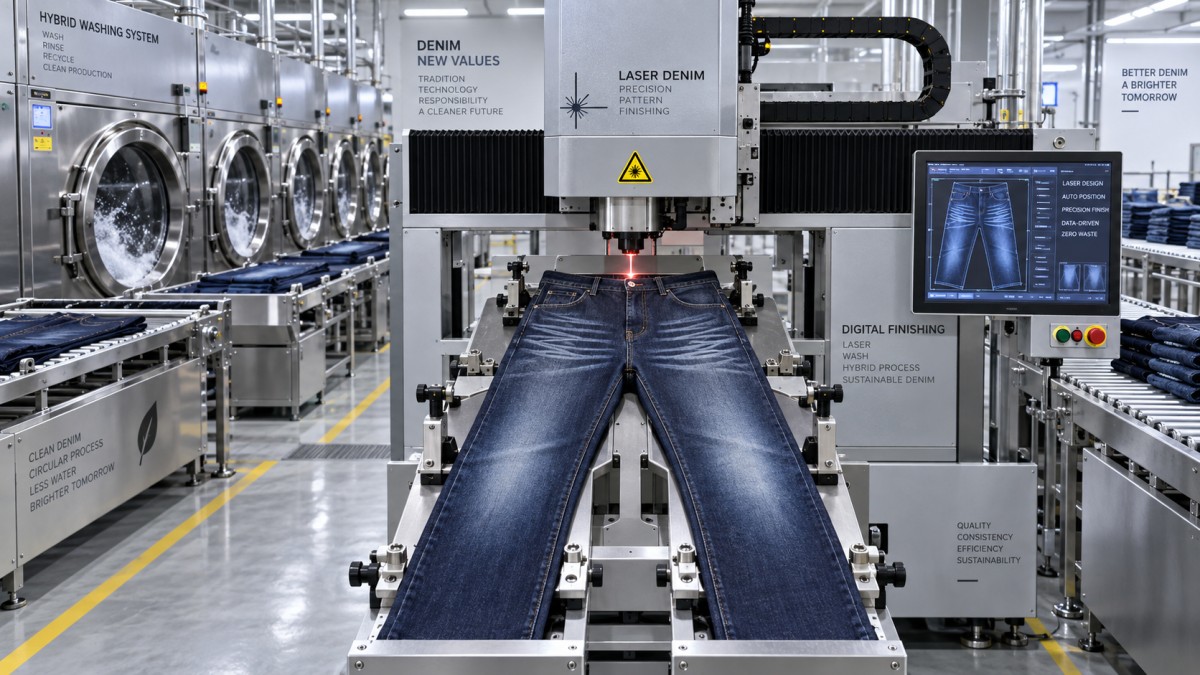
Laser engraving is more direct for localized visual effects. A programmed beam can fade selected areas, create whiskers, simulate abrasion, add holes or distressed marks, and apply text or graphics without physically treating each area by hand. Once the artwork and process settings are validated, changing from one approved pattern to another may be largely a software task rather than a new mechanical template or manual instruction cycle.
However, laser-treated garments commonly still require subsequent washing. The laser modifies or removes dye at the surface; a rinse or wash may be needed to remove residues, soften the appearance, stabilize the final look, or combine the engraved effect with broader garment character. Therefore, a realistic comparison is usually “laser plus a simplified wet route” versus “a conventional wash route with more manual local finishing,” not laser versus water in absolute terms.
In a stable, large-volume program with a simple all-over wash and little local detail, a well-run conventional laundry can be highly efficient. Its equipment may process many garments in one load. Laser’s advantage becomes clearer when the program demands multiple placements, short runs, frequent buyer revisions, or effects that would otherwise depend on skilled manual abrasion and inspection.
Where Laser Engraving Usually Saves Time
The most significant gain is often upstream, during development. A designer can alter the position, density, scale, or contrast of a whisker pattern in the file and run another sample without rebuilding physical aids or retraining operators on a new hand-finishing sequence. That is valuable for fashion teams that review products on screen, request localized changes, and expect sampling to keep pace with a compressed calendar.
Repeatability is another time-saving factor. Manual rubbing, spraying, and sanding can produce desirable uniqueness, but they also introduce variation between operators, shifts, and production periods. When a buyer’s reference sample must be matched closely, variation creates rechecking, sorting, correction, and sometimes reprocessing. A laser recipe cannot eliminate all variability—fabric lots, garment construction, and garment positioning still matter—but it gives the factory a more controlled starting point.
Laser also supports a more flexible production sequence. Different styles can be queued using separate digital files, provided the machine handling setup and garment positioning are compatible. This is particularly relevant for small-batch denim, direct-to-consumer collections, and cross-border e-commerce assortments where a factory may need to run many washes or visual stories in limited quantities.
Yet the machine itself is not automatically fast in every setting. Laser throughput depends on artwork coverage, desired fading depth, machine configuration, loading method, garment alignment, and the number of panels or sides to be processed. A sparse logo requires less beam time than a detailed full-leg vintage map. If operators spend excessive time aligning garments, correcting wrinkles, or handling complex constructions, the theoretical benefit can shrink quickly.
Traditional Washing Still Has Strengths That Laser Cannot Copy
Wet processing affects more than color. It can influence hand feel, drape, shrinkage, seam character, fabric texture, and the natural interaction between yarn, dye, and garment construction. Stonewashing, enzyme washing, and other established routes can produce depth and randomness that a laser pattern alone may struggle to imitate convincingly. For heritage denim, heavily washed workwear aesthetics, or products where tactile character is central, the wet process remains part of the design language.
There is also a capacity issue. A laundry built around high-volume batch processing may already have water treatment, drying, material handling, recipe control, and trained teams in place. Replacing a familiar route with laser involves capital expenditure, floor planning, safety systems, operator training, programming capability, maintenance procedures, and quality standards. The decision should be evaluated against the actual product mix rather than the promise of a cleaner-looking production flow.
A sensible approach is often hybrid finishing. Laser handles the precise, repeatable local fade or graphic; a reduced wet process adds softness, cleans the surface, and creates the final garment mood. This combination can remove some labor-intensive treatments while preserving the physical qualities that buyers expect from denim.
A Practical Comparison for Production Planning
The table is a planning guide, not a production-time calculation. Any factory considering an investment should conduct trials using its own denim weights, dye systems, seam constructions, and target finishes. A process that looks fast on a flat swatch may behave differently on a finished jean with thick seams, elastane content, pockets, and variable panel tension.
The Quality Risks Are Often Hidden in the File-to-Garment Gap
A laser system is only as dependable as its process control. The artwork must account for garment size grading, pocket placement, seam geometry, and the way a trouser leg sits on the machine form. A visually balanced fade in one size may shift noticeably in another. The same laser settings can also react differently when a mill changes indigo chemistry, yarn count, fabric weight, or stretch composition.
Over-processing is a separate concern. Excessive energy can weaken fibers, create an undesired yellow or brown cast, or produce harsh contrast that becomes more obvious after washing. Under-processing may leave the pattern faint or inconsistent. Neither issue is solved simply by increasing power. Beam settings, engraving speed, resolution, focus, ventilation, garment moisture condition, and the following wash route need to be developed as one system.
Quality teams should define what they are approving. Is the priority color contrast, placement accuracy, hand feel, durability after home laundering, or a deliberately irregular vintage appearance? Those priorities can conflict. A brand that asks for “natural randomness” should not later inspect every unit as if it were a digitally identical print.
Water Reduction Is Real, but It Is Not the Same as a Waterless Garment
Laser engraving is frequently discussed as an environmental alternative because it can replace some manual bleaching, sanding, spraying, or localized wet-effect steps. That is a meaningful operational direction, particularly where wastewater treatment, chemical handling, and worker exposure are major concerns. But it should not be described as making denim finishing automatically waterless.
Most commercial denim programs still involve washing, rinsing, drying, or softening somewhere in the route. The environmental result depends on what laser actually displaces, whether the remaining wet process has efficient water and energy management, how wastewater is handled, and whether rejected garments are reduced. A laser investment that lowers rework and eliminates a problematic manual process may have strong practical value even when it does not remove wet finishing entirely.
This systems view is central to the work followed by Global Advanced Textile & Finishing Systems (ATFS). Denim finishing is not isolated from fabric formation, dye behavior, cutting accuracy, or supply-chain timing. The same factory trying to shorten finishing lead times may also be dealing with fabric-lot consistency, automated cutting precision, digital design data, drying capacity, and the environmental performance of its dyeing and finishing infrastructure.
When Is Laser the Faster Choice?
Laser engraving is generally the stronger speed option when a manufacturer needs fast sample revisions, repeatable localized effects, frequent design changeovers, or reduced dependence on labor-intensive hand work. It is particularly suited to operations pursuing small-batch, quick-response denim without creating a separate manual process for every new fashion detail.
Traditional washing may remain more appropriate when the target look depends on broad garment transformation, deep tactile character, or established high-volume batch capacity. The fastest route can also be a hybrid one: use laser for precision and programming flexibility, then retain a carefully designed wash for the final hand feel and visual integration.
Before choosing either route, production teams should test complete garments rather than isolated fabric panels, compare the approved appearance after the final wash and dry, and map the true elapsed time from design revision to packed garment. That measurement reveals whether the real constraint is engraving, laundry capacity, manual finishing, quality approval, or internal material movement. In denim, the best technology decision usually begins there.
- Textile IoT Capital & EconomicsVDMA Opens ITMA 2027 Technical Delegation Pre-RegistrationVDMA opens ITMA 2027 technical delegation pre-registration. Explore German textile machinery, digital innovation and sustainability. Register interest by December 11, 2026.
- Fast Fashion & Agile MfgTextile OEM Compliance Evaluation: What to Check in a Supplier AuditTextile OEM compliance evaluation made practical: discover key supplier audit checks for quality, machinery, chemicals, traceability, and environmental risks.
- Textile IoT Capital & EconomicsTariffs and Inflation Weigh on Demand as U.S. Apparel Imports Fall to $56.68 BillionU.S. apparel imports fell 6.14% to $56.68 billion as tariffs and inflation weighed on demand. Explore what this could mean for buyers and exporters.
Related News
Get weekly intelligence in your inbox.
No noise. No sponsored content. Pure intelligence.
