




Short-run fabric printing is changing because the cost of being wrong has become more visible than the cost of producing quickly. A seasonal print that once justified a long production run may now be needed in several colorways, across a limited online release, followed by a fast reorder only if demand appears. Advanced digital textiles make that operating model practical by turning fabric printing from a plate-led manufacturing process into a data-led workflow.
The shift is not simply about putting more complex artwork on fabric. It changes when a brand can commit to a design, how a printer manages its production queue, how much unfinished inventory must be held, and how quickly a garment supplier can react to an unexpected demand signal. For short runs, the advantage usually comes from avoiding setup work and reducing decision time, rather than from trying to match the output economics of a high-volume rotary screen line.
Short runs no longer fit a plate-based production logic
Traditional textile printing remains highly capable, particularly when one stable design will be printed repeatedly at large scale. Screen preparation, color separation, engraving, setup, and cleaning are manageable when spread across a long run. They become harder to justify when a buyer needs a small launch quantity, a personalized collection, a regional test, or frequent artwork changes.
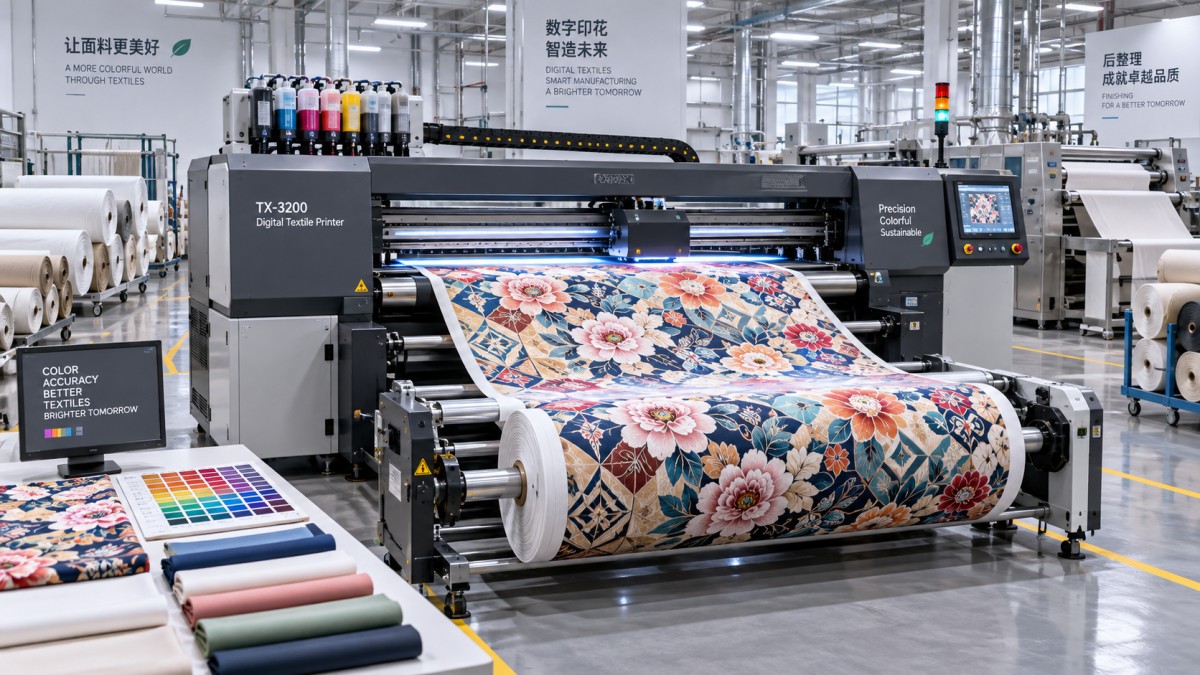
That mismatch is where advanced digital textiles have gained influence. Industrial inkjet systems receive a production file, apply ink directly to prepared fabric, and move from one design to the next with far less physical changeover. Micro-piezo printheads place controlled droplets where the image data specifies, allowing detailed motifs, tonal variation, and many-color artwork without creating a separate physical screen for each color.
The practical result is not that every order should become digital. It is that the economically sensible run length is no longer determined only by the cost of print hardware and setup. It is also shaped by forecast uncertainty, the value of speed, fabric availability, downstream sewing capacity, and the financial exposure of unsold goods.
A fashion label testing several prints for a direct-to-consumer drop, a home-textile seller refreshing a niche collection, and a supplier serving many small private-label accounts can all benefit from this flexibility. Their common need is not “digital” as a label. It is a production route that can absorb variation without creating disproportionate waste or delays.
Speed comes from removing handoffs, not only from faster printers
Digital textile printing is often described as on-demand production, but the printer is only one part of the response time. The more consequential change is the connection between design data, color management, fabric preparation, printing, fixation, washing where required, inspection, and cutting. A fast printer cannot create a short lead time if color approval waits in a separate system or if printed rolls sit idle before finishing.
For a short-run workflow, an approved artwork file should lead to a controlled recipe: the intended fabric base, pretreatment method, ink set, print profile, fixation route, and inspection criteria. This reduces ambiguity when the same design returns months later or is produced at a different site. It also makes reorders more predictable, which matters more than a one-off sample that looked acceptable under a particular set of conditions.
Digital printing supports another form of speed: design changes can happen later in the product-development calendar. Designers can adjust placement, scale, color direction, or size grading in the file rather than reopening a screen-development process. That does not remove the need for sample approval, but it can reduce the penalty for learning something late.
There is a limit. Short runs still require disciplined planning. Fabrics must be sourced, prepared, and available; inks and chemicals must match the fiber; and post-print processing must be scheduled. Treating digital printing as a button-click service creates avoidable delays. The better model is a compact production cell with clear ownership of data, material flow, and finishing.
Customization has moved from an exception to a manageable production variable
Screen printing is effective when repetition is the point. Digital print gives manufacturers a way to manage variation: multiple colorways in one run, localized artwork, different placements by garment size, or low-volume patterns tailored to a specific retail channel. This has direct value in markets where design breadth matters but any one design may have an uncertain sales life.
It also changes the relationship between sampling and production. A digital sample can be made through a process closer to final output than a separately simulated prototype. That makes it easier to assess print scale, detail retention, color interaction with the substrate, and the behavior of a motif near seams or garment panels. It does not guarantee bulk equivalence automatically, but it gives development teams a more relevant basis for decisions.
Personalization is the most visible use case, yet it is not always the strongest business case. Fully individualized orders introduce file handling, order validation, quality control, and fulfillment complexity. A more reliable early use of digital capacity is often controlled variation: a limited collection with several artwork versions, regional graphics, or short replenishment runs from approved files.
Fabric and ink chemistry still set the boundaries
A common mistake is to evaluate a digital textile printer only by image quality or claimed throughput. The printhead matters, but the fabric-ink-finish combination determines whether the final textile meets the intended standard for color, hand feel, fastness, stretch, and end use.
Natural-cellulosic fabrics such as cotton, linen, and viscose are often printed with reactive inks, which require appropriate pretreatment and a fixation and wash-off sequence. Pigment inks can work across a broader range of fibers and may simplify parts of processing, but the binder system and curing conditions affect handle and performance. Polyester commonly uses disperse chemistry through direct or transfer-based routes, each with different implications for fabric type, process flow, and application.
These choices should begin with the product, not the printer. A soft fashion fabric, a blackout curtain, a swimwear knit, and a technical polyester textile do not place the same demands on color, stretch recovery, abrasion resistance, or finishing. A vivid printed swatch is not enough evidence if the fabric will later be washed, heat-set, laminated, stitched, or exposed to prolonged light.
The sustainability case is operational, not automatic
Digital printing can reduce material waste by allowing production closer to confirmed demand and by avoiding screens and related setup consumables. It can also use ink more selectively than techniques that apply color across broad patterned areas. Those are meaningful advantages when a business would otherwise overproduce printed stock simply to make a conventional run economical.
However, calling any digital route “zero waste” or “zero pollution” ignores the rest of the process. Some fabric types need pretreatment. Certain ink chemistries require steaming and wash-off. Cleaning, rejected yardage, energy use, drying, and wastewater treatment remain part of the real environmental footprint. The relevant question is not whether a printer is digital; it is whether the entire print-and-finish route is being managed to reduce unnecessary inputs and rework.
This is why printing decisions increasingly sit beside dyeing and finishing decisions. An efficient color application step can lose its environmental advantage if fixation or finishing is poorly controlled. Conversely, well-managed low-liquor finishing, heat recovery, process monitoring, and more precise chemical dosing can improve the performance of the overall line. The market is moving toward integrated assessments because buyers are asking about both product responsiveness and production discipline.
Where the economics work, and where they do not
Digital printing is usually strongest where order sizes are variable, designs turn over rapidly, and inventory risk is expensive. It is well suited to fashion capsules, e-commerce launches, print-on-demand programs, boutique interiors, customized sportswear graphics, sampling, and replenishment of proven designs. It can also keep a supplier commercially responsive when customers request many small orders rather than a few predictable programs.
It is less compelling when a single design is stable, volume is high, fabric specifications are unchanged, and a conventional route has already absorbed its setup costs. In that setting, screen or rotary printing may retain a cost advantage. The point is not to replace every conventional line; it is to give a textile operation a viable route for work that conventional lines handle inefficiently.
Equipment decisions should therefore be based on the expected mix of work, not on an idealized average order. A facility that receives frequent artwork changes may value reliable job switching and color repeatability more than maximum linear speed. Another facility may need a hybrid model: digital capacity for sampling, launch quantities, and long-tail designs, with conventional production reserved for winning styles that reach sustained volume.
Color management is the quiet requirement behind repeatable output
Short-run printing exposes color inconsistency quickly because buyers may reorder after seeing the first lot. The desired result is not merely an attractive first print; it is a controlled result across jobs, dates, fabric lots, and production shifts. That requires a color-managed workflow with calibrated devices, approved targets, defined viewing conditions, and documented profiles for each relevant fabric and ink combination.
Fabric variability cannot be solved entirely in software. Changes in absorbency, whiteness, weave density, pile direction, or finishing can alter perceived color and detail. Operators need a process for identifying when a fabric lot falls outside the assumptions behind a profile. Without this, a team may blame the printer for an issue caused upstream by substrate variation.
Artwork preparation deserves equal attention. Raster images, vector elements, transparencies, black construction, repeat joins, and embedded color data all influence output. Short-run operations need file checks that are fast enough for agility but structured enough to prevent avoidable reprints. The cost of a flawed file rises when each run is small, because there is less volume over which to absorb the loss.
Digital print changes the cutting room as well
The effect of a printed fabric does not end at the roll. Placement prints, engineered stripes, and directional motifs create additional demands in cutting and sewing. A beautiful digital design can become an expensive garment problem if the pattern pieces cannot be aligned accurately or if the cutter does not recognize print registration marks.
Flexible automated cutting systems equipped with vision can support placement accuracy and pattern matching, especially for garments that rely on visual alignment. This does not mean every short-run producer needs a fully automated cutting line. It means the print file, marker plan, and cutting method should be considered together before a design is approved. The most profitable print is not necessarily the one with the most visual detail; it is the one that can be printed, cut, and assembled with a predictable yield.
That systems view is central to the work observed by The Global Advanced Textile & Finishing Systems (ATFS): printing performance is tied to fabric construction, finishing conditions, production data, and the realities of downstream conversion. For manufacturers assessing agile capacity, these connections are more useful than treating a printer purchase as an isolated equipment decision.
Questions to settle before investing or changing suppliers
Before comparing machines or print service providers, define the work that must be won or retained. “We need short runs” is too broad. A useful brief identifies the typical fabric families, the smallest and most common order sizes, how often artwork changes, required lead times, likely reorder patterns, quality expectations, and the finishing route needed after printing.
- Which designs create the greatest inventory risk under the current production method?
- Can the chosen process deliver the required color and handle on the actual fabrics, not only on a showroom swatch?
- Where will pretreatment, fixation, washing, drying, and inspection occur?
- How will approved color and print settings be retained for reorders?
- Can the cutting and sewing stages use the printed fabric efficiently, particularly for placement or directional prints?
- Which jobs should remain on conventional equipment because their volume and stability support it?
The market direction is clear: fabric printers are being asked to respond to more designs, less certainty, and tighter delivery windows. Advanced digital textiles provide the production flexibility to meet that demand, but their strongest value appears when the full workflow is designed around it. The organizations that benefit most will be those that treat digital printing as a connected manufacturing capability, balancing print technology with chemistry, color control, finishing, and the practical economics of the next order.
- Textile IoT Capital & EconomicsVDMA Opens ITMA 2027 Technical Delegation Pre-RegistrationVDMA opens ITMA 2027 technical delegation pre-registration. Explore German textile machinery, digital innovation and sustainability. Register interest by December 11, 2026.
- Fast Fashion & Agile MfgTextile OEM Compliance Evaluation: What to Check in a Supplier AuditTextile OEM compliance evaluation made practical: discover key supplier audit checks for quality, machinery, chemicals, traceability, and environmental risks.
- Textile IoT Capital & EconomicsTariffs and Inflation Weigh on Demand as U.S. Apparel Imports Fall to $56.68 BillionU.S. apparel imports fell 6.14% to $56.68 billion as tariffs and inflation weighed on demand. Explore what this could mean for buyers and exporters.
Related News
Get weekly intelligence in your inbox.
No noise. No sponsored content. Pure intelligence.
