




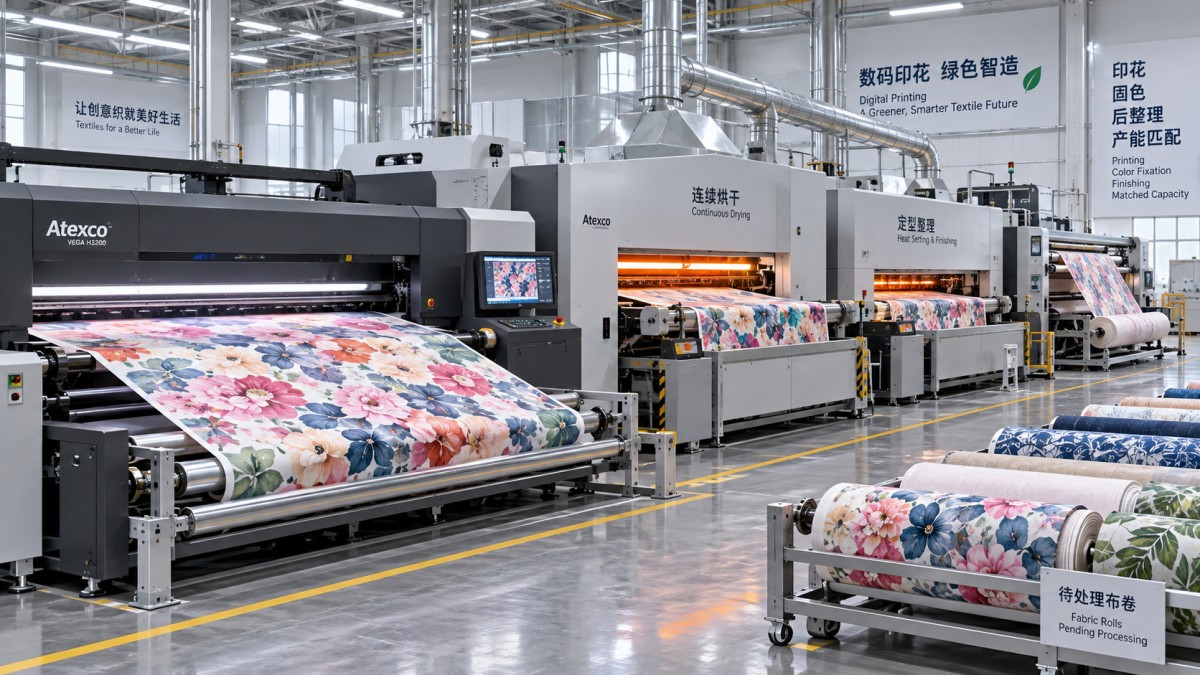
Yes, fabric printing machines can match an existing finishing line's effective speed, but only when the comparison is made across the whole process rather than at the printer's quoted belt speed. A digital printer may move fabric quickly while the line still loses output through pretreatment, moisture control, fixation, washing, drying, edge guidance, or inspection. Conversely, a printer with a lower nominal speed can keep a finishing line productive when it runs continuously, changes designs without plate preparation, and feeds downstream equipment in stable, usable batches.
The practical question is therefore: can the printing stage deliver the required fabric width, quality, moisture condition, and roll continuity at the rate required by the next constrained process? The answer changes with fibre type, ink chemistry, print coverage, curing method, fabric construction, and whether printing is installed inline or operated as a buffered production cell.
Compare effective throughput, not headline speed
Finishing equipment is often described in metres per minute. That figure is useful, but it is incomplete. A stenter, dryer, steamer, washer, or compactor may have a mechanical maximum speed that cannot be sustained for every fabric. Fabric weight, residual water, target handle, tension sensitivity, dwell time, and temperature uniformity set the usable rate.
Digital textile printers have the same distinction. Their transport belt may be capable of a high speed, while the usable production rate falls when print resolution rises, ink laydown increases, nozzle checks interrupt output, or a dark ground requires several ink channels to fire heavily. A speed comparison should use comparable conditions:
- Finished metres per hour: include cleaning cycles, splice time, start-up waste, roll changes, and required pauses for printhead maintenance.
- Finished square metres per hour: this is more meaningful when line widths differ. A narrow printer running faster is not automatically equal to a wider finishing range.
- Saleable output: exclude metres held for colour correction, banding, strike-off approval, reprint, or downstream defects caused by incomplete fixation.
- Matched recipe conditions: compare the actual design coverage, resolution, fabric width, and ink chemistry expected in production, rather than a low-coverage demonstration file.
A finishing line that processes plain-dyed fabric at a rapid rate may not be the right benchmark for heavily printed reactive cotton. Reactive inks need controlled drying before steaming, followed by washing to remove unfixed dye and thickener. The combined residence time of those stages can be much longer than the printer pass itself. Pigment printing, by contrast, often avoids the extensive wash-off sequence but demands well-managed drying and curing to achieve rub resistance and handle without damaging the fabric.
Find the real bottleneck before sizing the printer
There is rarely one “finishing line speed.” Most lines contain several sections with different physical limits. The slowest stable section establishes the line's effective capacity. On a continuous process, the fabric cannot simply accelerate through a dryer because a printer upstream has spare capacity. Tension, dwell time, and fabric tracking must remain controlled across the full web path.
Start by mapping each stage from greige or prepared fabric to inspected roll. Record the usable width, target metres per hour, planned operating hours, normal changeover time, and typical yield loss. Then distinguish processes that must run in direct sequence from those that can be separated with a buffer.
A line with a stenter operating at a certain speed should not automatically receive a printer with the same nominal figure. If the printer outputs finished-width fabric while the stenter runs wider, their area capacities differ. If the stenter is occupied with heat setting polyester between printed lots, it is not continuously available to the printing route. Scheduling availability is a capacity issue, not an administrative detail.
Ink chemistry determines whether inline matching is realistic
The printing method sets the downstream burden. This is why two machines with identical print widths and apparent speeds can fit entirely different finishing environments.
Reactive ink on cotton, viscose, linen, and blends
Reactive printing requires prepared fabric with reliable absorbency and alkali conditions. After printing, moisture must be removed carefully enough to prevent migration, then the dye is fixed through steaming. Washing removes unfixed dye, alkali, and thickener. The printer's output is only one part of a process route in which steaming and washing must provide sufficient residence time and consistent chemistry. When the existing wash range has limited capacity, raising printer speed simply transfers the bottleneck downstream.
Print coverage matters sharply here. A fine, open motif and a saturated full-width design can consume very different amounts of ink and impose different washing loads. Capacity planning based on a sparse sample file will overstate output for fashion prints with dense grounds, large dark areas, or repeated colour blocks.
Acid ink on silk, wool, nylon, and polyamide
Acid ink workflows also rely on controlled fixation, commonly through steaming, and their speed fit depends on fibre sensitivity as well as colour development. Delicate fabrics may require conservative web tension and careful drying. A finishing line that handles robust woven polyester smoothly may need a different path, tension setting, or batch strategy for lightweight silk or elastic nylon constructions.
Disperse ink on polyester
For polyester, fixation can involve high-temperature processes suited to the chosen ink and fabric route. Heat setting, thermal transfer, or other thermal stages need to be evaluated for dwell time and temperature uniformity. Polyester's dimensional stability does not eliminate risk: uneven heat exposure can affect shade, sublimation behaviour, and width. When printed goods share a stenter with other finishing work, the ability to hold the required thermal recipe may matter more than its nominal line speed.
Pigment ink for streamlined finishing
Pigment printing can reduce water-intensive wash-off operations because the colourant is bound near the fabric surface with a binder system. That can make speed matching easier where washing is the existing constraint. The trade-off sits in curing, hand feel, elasticity, and fastness requirements. Heavy binder add-on, inadequate cure, or unsuitable fabric preparation can produce cracking, stiff handle, weak rub performance, or uneven appearance. Eliminating a wash stage does not mean that drying and curing can be treated casually.
Use buffers to decouple processes that should not be forced together
Direct inline integration is attractive because it reduces handling and work-in-process. It works best when fabric type, pretreatment, ink set, fixation route, and downstream availability remain stable for long enough runs. Digital printing often serves short runs and frequent artwork changes, however, while finishing equipment may be most efficient on longer, recipe-consistent batches. Forcing both into a rigid synchronous line can create idle time at either end.
A controlled buffer between printing and fixation is often more productive than an uninterrupted physical connection. Printed fabric can be wound with suitable tension control, identified by job and recipe, and moved to fixation in a sequence that maintains traceability. The buffer must protect the printed surface from offsetting, contamination, excessive compression, and unsuitable storage conditions. For reactive or acid routes, the allowable waiting period should be validated against the specific pretreatment and fixation process; treated or printed fabric does not necessarily remain equally stable indefinitely.
Buffer sizing is not just a question of floor space. It should cover realistic interruptions: printhead recovery, fabric roll changes, steamer cleaning, washing-range preparation, inspection holds, and colour approval. A buffer that stores only a few minutes of output does little when a downstream thermal section takes substantially longer to restart.
Fabric handling can limit speed before printing quality does
High-precision printing exposes web-handling defects that plain finishing sometimes tolerates. A fabric entering the printer with variable width, loose edges, bow, skew, wrinkles, or unstable tension will not remain accurately registered merely because the printer has precise carriage motion. Camera systems can compensate for some placement variation, but they cannot correct a web that shifts unpredictably under the print zone.
Knits, stretch fabrics, open constructions, and lightweight fabrics deserve separate trials from stable woven goods. Stretch recovery after printing and finishing can shift motif dimensions. Open fabrics may show strike-through or uneven penetration. Brushed or raised surfaces alter ink reception and drying behaviour. Coated substrates may need specific surface energy or primer conditions. These are not minor quality details: each can require a lower transport speed, modified drying profile, or a different tension path.
Edge guidance is especially important when the printed design must align with later cutting, panel placement, or repeat registration. A line may meet metres-per-hour targets while still creating material that cannot be cut accurately. The useful speed is the rate at which fabric exits within dimensional and visual tolerance.
Run a capacity trial with production files and downstream validation
The most reliable way to determine fit is a connected trial that follows representative fabric through the actual route. A printer-only demonstration cannot establish whether the existing finishing line can absorb the work. Use a set of files that reflects the order mix: low and high coverage, light and dark colourways, fine detail, large solid areas, and the expected repeat lengths. Include the narrowest and widest relevant fabrics, plus constructions known to challenge tracking or drying.
- Set the required output as saleable square metres per shift or per scheduled production window, then translate it into a needed printer rate at the real usable width.
- Measure the print stage over enough time to include priming, nozzle recovery, fabric splicing, roll changes, and normal cleaning. A short uninterrupted run only measures the best moment of the process.
- Follow the same material through fixation, wash-off where required, drying, stentering, and inspection. Record queues and hold times rather than looking only at individual machine readings.
- Compare colour, penetration, handle, shrinkage, width, bow, skew, and defect levels from the beginning and end of the run. A faster setting that creates rework has not matched the line.
- Review job data by roll, including fabric lot, pretreatment recipe, print file, ink batch, speed, temperature profile, and inspection result. This makes recurring bottlenecks visible instead of attributing every issue to the printer.
Where automated data exchange is available, synchronize job status across pretreatment, printing, fixation, inspection, and roll storage. The purpose is not merely to display machine speed. It is to prevent an unprepared roll from reaching the printer, a printed roll from waiting without status, or a finished roll from losing its link to the file and process recipe. Traceability becomes particularly valuable when a shade shift appears only after washing or curing.
Common speed-matching errors
Matching metres per minute across unequal widths. This understates or overstates capacity immediately. Use area throughput and account for selvedge loss, printable width, and the width retained after finishing.
Assuming a single print mode represents every design. Resolution, pass count, ink limits, and coverage determine the productive rate. A mode selected for sharp detail may not be necessary for all work, while a fast mode may reveal banding or poor edge definition on demanding artwork.
Ignoring thermal dwell time. Dryers, steamers, and curing ovens are governed by time at condition, not by how quickly fabric can be pulled through without breaking. Raising speed without revisiting the thermal profile risks incomplete fixation, residual moisture, colour variation, or insufficient cure.
Treating inspection as an afterthought. Digital print defects can be intermittent: missing nozzles, colour drift, registration variation, or contamination may emerge mid-roll. Inline vision systems and disciplined inspection reduce the chance that high-speed output becomes a large downstream hold.
Using one process recipe for materially different fabrics. A workable setting for a stable cotton poplin may fail on a viscose twill, a stretch knit, or a low-basis-weight polyester. The need for separate speed windows is normal process control, not evidence that the printer is underperforming.
Fabric printing machines can keep pace with existing finishing lines when the selected print mode, fabric width, ink route, fixation capacity, and handling conditions are matched as one production system. When those conditions do not align, the sound response is usually not simply a faster printer. It is a revised process route, a properly sized buffer, a dedicated downstream window, or a realistic output target based on saleable finished fabric.
- Textile IoT Capital & EconomicsVDMA Opens ITMA 2027 Technical Delegation Pre-RegistrationVDMA opens ITMA 2027 technical delegation pre-registration. Explore German textile machinery, digital innovation and sustainability. Register interest by December 11, 2026.
- Fast Fashion & Agile MfgTextile OEM Compliance Evaluation: What to Check in a Supplier AuditTextile OEM compliance evaluation made practical: discover key supplier audit checks for quality, machinery, chemicals, traceability, and environmental risks.
- Textile IoT Capital & EconomicsTariffs and Inflation Weigh on Demand as U.S. Apparel Imports Fall to $56.68 BillionU.S. apparel imports fell 6.14% to $56.68 billion as tariffs and inflation weighed on demand. Explore what this could mean for buyers and exporters.
Related News
Get weekly intelligence in your inbox.
No noise. No sponsored content. Pure intelligence.
