




Reactive printed cotton fabric needs single-pass printing when the production constraint is no longer image capability but throughput: a large enough volume of digitally printed meters must move through the line quickly, with frequent artwork changes and stable repeat quality. The decision is justified only when the printer, pretreatment range, steamer, washer, dryer, and inspection process can sustain one another. A fast print carriage alone does not create fast finished fabric.
Single-pass architecture places fixed inkjet printheads across the fabric width. Fabric travels continuously beneath them, unlike a scanning machine in which a carriage passes back and forth. This removes carriage travel as the principal speed limit, but transfers more responsibility to every upstream and downstream condition. With reactive inks, the printed cloth still requires controlled drying, steaming for fixation, and thorough washing-off to remove unfixed dye and auxiliaries. The relevant capacity is therefore finished, approved fabric per shift, not the nominal speed displayed on the printer.
When the single-pass case becomes strong
The clearest trigger is a sustained demand for repeatable production runs that are too large or too frequent for scanning output to absorb without creating a queue. A line running one design for an extended length benefits from continuous fabric movement, especially where the same base cloth and color process recur across multiple orders. Shorter runs do not automatically rule out single-pass. If a plant receives a dense stream of small orders with similar cotton constructions, fast file changes and immediate print readiness can preserve the advantage, provided cleaning and verification between designs are disciplined.
Reactive printed cotton also favors the technology when color expression must remain consistent across a broad production window. Cotton accepts reactive dyes through a chemical bond formed during steaming, so the appearance of the final print is shaped by more than drop placement. Pretreatment moisture pickup, alkali distribution, fabric pH, drying condition, steam saturation, wash sequence, and fabric tension all influence the result. Once these variables are held within a controlled operating band, single-pass printing delivers uniformity across long lengths without the interruptions inherent in repeated carriage scans.
A high product mix can still be compatible with a single-pass line, but only when design variation is separated from substrate variation. Changing artwork files is comparatively quick. Changing from a compact poplin to a brushed sateen, a slubbed voile, or a heavy twill changes ink absorption, strike-through, drying behavior, and washing response. If the order book repeatedly alternates between incompatible cotton constructions, the speed advantage can be lost in pretreatment resets, color adjustments, and cleaning. The better fit is a production pattern with many images but a controlled family of prepared fabrics.
Throughput must be measured across the whole wet process
A frequent evaluation error is to compare printer speed with the output of an existing rotary or scanning printer without including fixation and wash-off. Reactive ink is not a pigment system that can simply be dried and sent onward. After printing, moisture and heat in the steamer enable dye migration and reaction with cellulose. Unreacted dye, thickener residues, salts, and alkali then have to be washed away. If the steamer lacks residence time at the required fabric load, or if the washing range is constrained by water exchange and temperature control, print speed becomes a source of accumulating semi-finished inventory.
The limiting point is often visible as fabric waiting before steaming, rolls waiting wet after steaming, or inspection finding shade drift between the first and last portions of an order. These symptoms should not be attributed automatically to the printheads. A wet queue can alter fabric moisture and surface condition before fixation. Insufficient wash capacity may leave poor white-ground clarity or lower wet-rub performance even when the printed image looks sharp before washing.
Capacity balancing also needs to account for rejected meters and process interruptions. A single-pass machine can print a substantial length before a missing nozzle, fabric crease, coating streak, or color deviation is noticed. The practical question is how quickly the line identifies a fault, stops or corrects it, and segregates affected fabric. A lower nominal speed with reliable inline monitoring may produce more saleable output than a faster configuration that creates long defect sections.
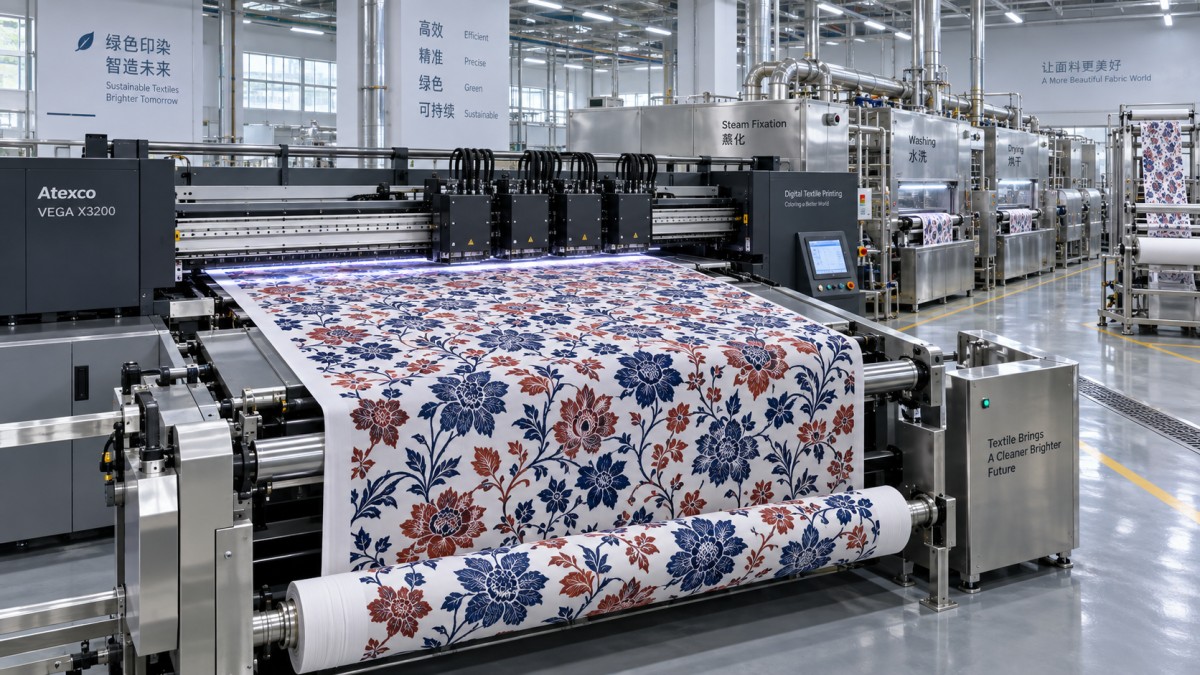
Image type and color demand matter more than design complexity alone
Complex artwork is often cited as the reason to adopt single-pass printing, yet complexity by itself is not decisive. Fine line work, photographic gradients, dark grounds, and saturated reds or navies increase the demands on waveform control, drop placement, ink limits, pretreatment, and fixation. They can be produced successfully, but they require a validated process window. A plant printing mostly light motifs on white cotton faces a different risk profile from one producing dense all-over fashion prints with large areas of high ink coverage.
High coverage raises moisture load and can expose poor fabric preparation. Excessive ink on inadequately dried pretreatment can cause feathering, uneven penetration, blurred edges, or a change in shade after steaming. Reducing ink to protect definition may then reduce depth of color. This is not solved by selecting a faster printer alone. The ink set, print resolution, pass configuration, drying energy, and prepared-fabric specification must be set as one production recipe.
Color consistency should be assessed after the complete reactive process, not from a pre-steam strike-off. Freshly printed cloth can appear brighter or darker than the washed result. The final result is affected by dye fixation and by wash-off efficiency, particularly in white grounds and pale colors where unfixed dye is readily visible. Approval work should use the intended cotton quality, intended pretreatment, intended print mode, and intended steaming and washing route. Substituting a laboratory-prepared swatch for production-prepared fabric can conceal the very variation that later causes a failed bulk run.
Prepared fabric is the real entry condition
Single-pass printing requires uniform prepared fabric because fixed printheads expose any variation repeatedly across the width. Cotton should arrive clean, absorbent, and free of finishing residues that interfere with wetting. The pretreatment layer normally provides the chemicals needed for reactive dye fixation as well as ingredients that control drop spread and surface behavior. Its application must be even in both cross direction and length direction. A small coating variation can become a visible shade lane once repeated through a full-width print.
Fabric construction deserves equal attention. Open weaves may show more strike-through; dense sateens can hold color near the face; textured surfaces may disrupt fine edges; and residual movement in loosely stabilized cotton can complicate registration. These are material behaviors, not universal printer defects. The selected print mode should be verified on the actual weight, weave, yarn count, whiteness level, and finished width that will enter bulk production.
Roll handling has a direct effect on image quality. Uneven winding, telescoped rolls, crease marks, variable tension, and storage conditions can lead to feed instability or localized print variation. A single-pass line is most productive when incoming rolls are traceable to their preparation batch and their condition is checked before loading. Where a defect is traced to a coating batch, this connection prevents the same issue from being mistaken for an ink or nozzle failure.
Operational control is part of the capital decision
The investment case should include the procedures needed to keep a high-speed inkjet system stable. Reactive inks require filtration, controlled circulation, and disciplined cleaning to protect printhead health. Nozzle checks must occur at a frequency that reflects both speed and design sensitivity. A missing nozzle may be nearly invisible in a textured, multicolor pattern but conspicuous in a pale solid field or long vertical stripe. Inspection criteria need to reflect the actual product mix rather than a generic test image.
Environmental control around the printer also affects reliability. Dust and lint from cotton, static conditions, temperature shifts, and changes in relative humidity can influence fabric transport, printhead condition, and drop behavior. The print room, material staging area, and maintenance routine cannot be treated as separate from production quality. When a trial performs well under controlled conditions but bulk output shifts across shifts or seasons, the cause often lies in those operating conditions rather than the digital file.
Data integration becomes valuable when it links roll identity, pretreatment batch, artwork version, ink lot, print recipe, steamer settings, wash route, and inspection result. That record makes it possible to distinguish a recurring substrate problem from a one-time machine event. It also prevents an approved color recipe from being applied to a similar-looking but differently prepared cotton base.
Situations where scanning remains the better fit
Single-pass is not automatically the right answer for reactive printed cotton. Scanning equipment remains persuasive when annual printed volume is uncertain, order gaps are long, production involves many unstable fabric types, or the line must prioritize experimentation over sustained throughput. It can also be the more controlled route for niche work where each design needs individualized adjustment and the cost of idle high-speed capacity would outweigh the benefit of faster printing.
The distinction should not be reduced to “short runs versus long runs.” A short, urgent repeat order on a stable prepared cotton base may suit a single-pass route well. A long order composed of inconsistent greige fabric, unvalidated pretreatment, and difficult high-coverage artwork can be a poor candidate. The useful dividing line is whether the entire process has enough repeatability to convert printing speed into approved, washed fabric.
A disciplined trial should imitate bulk production
Before committing to a single-pass configuration, run representative artwork across the intended fabric range and include both low-coverage and high-coverage designs. Evaluate color after wash-off, inspect face and back, measure width and distortion after finishing, and retain samples from the beginning, middle, and end of each roll. A trial that prints only a short section, bypasses normal wash conditions, or uses specially prepared fabric is useful for image demonstration but weak for equipment selection.
The final decision becomes defensible when the expected order pattern can keep the print line and wet process balanced, approved fabric quality is demonstrated at production conditions, and the operating team can detect faults before they propagate. Under those conditions, single-pass printing turns reactive cotton from a digital sampling process into a continuous production route without sacrificing the color and hand expected from the fabric.
- Textile IoT Capital & EconomicsVDMA Opens ITMA 2027 Technical Delegation Pre-RegistrationVDMA opens ITMA 2027 technical delegation pre-registration. Explore German textile machinery, digital innovation and sustainability. Register interest by December 11, 2026.
- Fast Fashion & Agile MfgTextile OEM Compliance Evaluation: What to Check in a Supplier AuditTextile OEM compliance evaluation made practical: discover key supplier audit checks for quality, machinery, chemicals, traceability, and environmental risks.
- Textile IoT Capital & EconomicsTariffs and Inflation Weigh on Demand as U.S. Apparel Imports Fall to $56.68 BillionU.S. apparel imports fell 6.14% to $56.68 billion as tariffs and inflation weighed on demand. Explore what this could mean for buyers and exporters.
Related News
Get weekly intelligence in your inbox.
No noise. No sponsored content. Pure intelligence.
