




How Long Does It Take to Change Fabric Width on a Stenter Machine?
How long does a stenter machine take to change fabric width? Most mills can complete a routine width change in 10 to 30 minutes.
However, total production-ready changeover time may reach 30 to 60 minutes when fabric handling, recipe changes, pin-chain cleaning, and quality approval are included.
For textile manufacturers serving short runs and fast-fashion programs, width adjustment speed affects delivery reliability, energy consumption, operator productivity, and usable machine capacity.
Typical Stenter Width Changeover Times
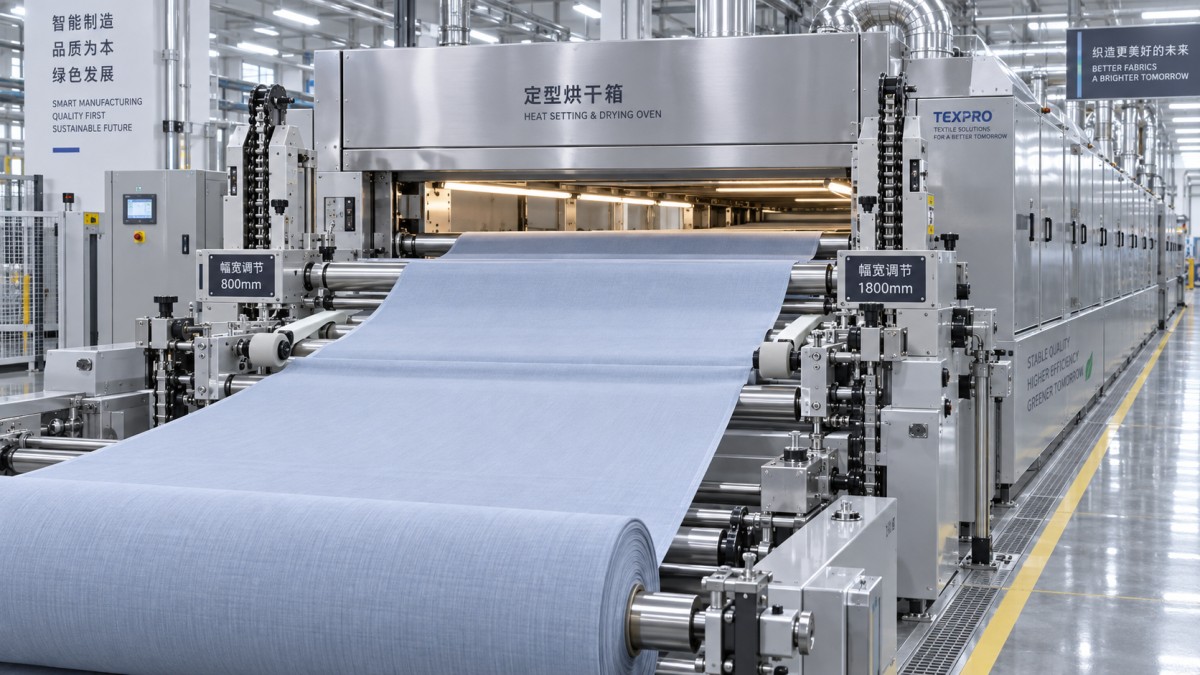
A modern automated stenter can mechanically reposition its chains or clips within several minutes, especially when servo-controlled width adjustment is available.
In practice, the mechanical movement is only one part of the answer. The complete changeover begins when the previous fabric leaves the machine.
It ends only after the next fabric runs steadily at the required width, tension, overfeed, temperature, moisture level, and appearance standard.
For a simple change between similar cotton or polyester fabrics, experienced operators may complete the whole task in 15 to 25 minutes.
A semi-automatic stenter with manual chain adjustment often requires 25 to 45 minutes, depending on machine length and operator coordination.
Older machines with hand-operated width screws, limited position feedback, or difficult access points can take 45 minutes or longer per change.
Complex changes usually take longer. Moving from lightweight knitwear to heavy woven fabric may require different pinning, edge guidance, overfeed, and drying settings.
Changing width by a small amount, such as 20 to 50 millimeters, is usually faster than shifting from narrow apparel fabric to wide home-textile material.
Production managers should therefore distinguish between “width adjustment time” and “line-ready changeover time” when comparing stenter performance.
The first measures chain movement. The second measures the downtime that actually affects order completion, machine utilization, and manufacturing cost.
What Determines How Long a Stenter Machine Takes to Change Fabric Width?
Machine design is the first major variable. Stenters with motorized chain drives and stored width positions reduce manual intervention and positioning errors.
Servo systems can move both chains simultaneously to programmed setpoints, making repeat orders faster and improving consistency between operators and shifts.
Manual systems require operators to loosen, move, verify, and secure adjustment points. This process becomes slower on long machines with multiple chambers.
Fabric type also changes the workload. Delicate fabrics require careful edge engagement because damaged selvedges can create waste or visible finishing defects.
Stretch fabrics need especially controlled tension during entry. Incorrect chain spacing or pinning can distort width, cause bowing, or create uneven residual shrinkage.
Heavy denim, coated textiles, technical laminates, and high-density woven fabrics may need slower threading and more careful edge alignment than lightweight constructions.
The difference between pin stenters and clip stenters matters as well. Pin systems demand reliable selvedge penetration, while clips require secure edge gripping.
Recipe complexity can add more time than physical width movement. Temperature, fan speed, overfeed, exhaust, moisture control, and dwell time may all require adjustment.
When a new fabric has a different fiber blend or chemical finish, operators may need trial meters before they can confirm the correct finished width.
Finally, the mill’s workflow determines repeatability. A prepared team with documented recipes can complete a change much faster than a team making decisions during downtime.
Why Finished Width Is More Important Than Chain Width
Many buyers ask only how quickly the chains can move. Mills should focus instead on how quickly they can achieve approved finished fabric width.
Fabric width at the stenter entry is not always the same as width at delivery. Heat, tension, moisture, and overfeed can alter the result.
For knitted fabrics, width recovery and relaxation behavior are particularly important. Excessive tension may temporarily create width while harming dimensional stability after washing.
For woven fabrics, warp and weft density, finishing chemistry, and moisture content can influence how the material responds inside the stenter chambers.
A fast mechanical adjustment that produces off-width fabric is not a productive changeover. It may create rework, downgraded rolls, claims, or cutting losses.
Operators should verify width at defined points rather than relying on a single measurement immediately after machine entry or at the delivery end.
Useful checks include usable width, selvedge condition, crosswise tension, bow and skew, surface appearance, residual shrinkage, and shade consistency where applicable.
Quality teams should set acceptable approval limits before production starts. That prevents repeated trial adjustments caused by unclear ownership or inconsistent specifications.
For export programs, the required width should match the customer’s usable-width definition. Nominal width and cuttable width are not always identical commercial measures.
The best stenter changeover process balances speed with stable quality, ensuring that recovered production time does not create avoidable downstream losses.
A Practical Width Changeover Workflow for Mill Teams
Efficient changeovers begin before the current order ends. The next fabric roll, recipe, quality target, and operating instructions should be ready in advance.
The production planner should confirm the next order’s target width, tolerance, fabric construction, finishing route, chemical treatment, and expected machine speed.
Operators should review whether the next fabric needs pins or clips, special edge guidance, a different padder setup, or changed overfeed settings.
Once the previous order is complete, the team should remove remaining fabric safely and inspect chains, pins, clips, and edge-guiding components.
Cleaning during changeover is important when lint, resin, coating residue, or finishing chemicals could affect edge holding or contaminate the next fabric.
The operator then adjusts the stenter width to the prescribed starting position. A documented starting value reduces unnecessary trial-and-error movement.
The next fabric should be threaded with correct alignment before entering heated chambers. Poor entry alignment creates problems that become harder to correct later.
Run a short trial length and measure the fabric after stable heating conditions are reached. Do not approve width based only on cold entry measurements.
If results fall outside tolerance, make controlled adjustments one variable at a time. Changing width, tension, and overfeed simultaneously obscures the real cause.
After approval, record final machine settings, actual changeover duration, fabric behavior, and any exceptions. This creates useful data for future repeat orders.
How Automation Reduces Stenter Width Changeover Downtime
Automation does not eliminate every changeover task, but it can remove repetitive manual adjustments and improve the predictability of width-related operations.
Automatic chain-width positioning is one of the most direct upgrades. Operators can select stored settings instead of measuring and adjusting each side manually.
Digital width indicators provide immediate confirmation that left and right chains are positioned correctly. This reduces asymmetry that can affect fabric tracking.
Recipe management systems link width positions with thermal settings, overfeed, fan control, and speed. This helps operators load proven parameters consistently.
Integrated fabric edge sensors can reduce setup time by improving centering and helping the fabric enter the stenter without repeated manual correction.
Automatic pin-chain lubrication and cleaning systems may not shorten every adjustment directly, but they reduce interruptions caused by poor chain condition.
Machine vision can support quality verification by detecting edge defects, wrinkles, width variation, or distortion before large quantities of fabric are processed.
For mills with frequent order changes, data connectivity is especially valuable. Production systems can identify the next recipe and prepare the machine sequence earlier.
Automation investments should be evaluated against order frequency. A mill running long, stable batches may gain less than a mill handling many small-lot programs.
The strongest business case usually combines reduced downtime, lower rework, faster operator training, improved repeatability, and more reliable delivery commitments.
Where Width Changes Create Hidden Costs
A 20-minute width change may appear minor, but repeated several times daily it can remove substantial production hours from an expensive finishing line.
Consider a stenter operating three shifts with six width-related changeovers per day. Saving ten minutes per change releases one additional production hour daily.
That hour includes more than throughput value. It also represents fuel, electricity, labor, compressed air, and heat-up capacity used more efficiently.
Frequent changes can also increase fabric waste. Trial lengths, rejected starts, damaged selvedges, and off-width rolls consume material before stable production begins.
The downstream impact can be larger than the finishing loss. Incorrect width can disrupt garment marker efficiency, automated cutting accuracy, and order consumption calculations.
For technical textiles, dimensional inconsistency may affect laminating, coating, bonding, printing registration, or final product compliance requirements.
Management should track changeover loss as a defined performance metric rather than treating it as unavoidable operator downtime.
Useful indicators include average changeover minutes, first-pass approval rate, trial-meter consumption, off-width rejection rate, and percentage of planned production time.
These measures reveal whether delays come from machine limitations, incomplete preparation, unclear recipes, maintenance issues, or quality approval bottlenecks.
How to Improve Changeover Speed Without Sacrificing Fabric Quality
Start with a time study. Observe several actual width changes and separate preparation time, mechanical adjustment time, threading time, trial time, and approval time.
This simple breakdown often exposes delays that machine upgrades alone cannot solve, such as missing rolls, unavailable recipes, or waiting for quality personnel.
Create standard operating procedures for common fabric groups. Similar knits, wovens, stretch materials, and coated fabrics should have clear setup references.
Store proven recipes with fabric construction details, target finished width, chain position, speed, temperatures, overfeed, and quality notes from prior production.
Use preset tooling and prepare edge-guiding components before stopping the machine. External preparation reduces the amount of work performed during downtime.
Train operators to identify fabric-specific risks early. Correct handling at the entry zone prevents repeated correction later in the drying and finishing stages.
Maintain chains, pins, clips, bearings, sensors, and width drives routinely. Mechanical resistance and worn gripping surfaces are common sources of slow changeovers.
Coordinate production sequencing where possible. Grouping orders with similar widths, fabric weights, and finishing recipes can reduce disruptive adjustments between batches.
However, sequencing should not create unacceptable delivery delays. The right balance depends on promised ship dates, order value, and customer service requirements.
Review results weekly with production, maintenance, quality, and planning teams. Improvement usually requires coordinated decisions rather than pressure on operators alone.
When Should a Mill Upgrade Its Stenter Width Adjustment System?
An upgrade becomes more compelling when width changes are frequent, manual adjustment creates inconsistent results, or downtime prevents the mill from accepting profitable short-run orders.
Older equipment may still deliver acceptable quality, but its labor-intensive setup can become a competitive disadvantage in responsive apparel and textile supply chains.
Before investing, calculate annual lost hours from changeovers and multiply them by realistic contribution margin, energy cost, labor cost, and rejected-fabric exposure.
Also consider operator availability. Automated positioning can preserve know-how in a digital recipe while reducing dependence on a small number of experienced technicians.
For mills producing repeat styles, stored width positions and recipes can offer rapid payback because the same settings are used many times each season.
For highly variable custom work, flexibility and ease of adjustment may matter more than maximum operating speed or the number of available recipe slots.
Ask equipment suppliers for demonstrated changeover data using fabrics similar to your own. Generic timing claims have limited value without comparable material conditions.
Evaluate the complete workflow, including threading, edge control, recipe loading, quality measurement, and machine cleaning, rather than evaluating chain movement alone.
Conclusion: Set Realistic Expectations for Stenter Width Changes
How long does a stenter machine take to change fabric width? A practical answer is 10 to 30 minutes for routine changes and longer for complex transitions.
The most important measure is not simply chain movement speed. It is the time needed to reach approved, stable finished width with minimum trial fabric.
Mills can improve performance through preparation, standard recipes, disciplined maintenance, operator training, sensible order sequencing, and targeted automation investments.
For manufacturers pursuing small batches, quick response, and consistent finishing quality, reducing stenter changeover time is a direct route to stronger capacity utilization.
Track actual results, identify the largest delays, and prioritize improvements that protect both fabric quality and commercial delivery performance.
- Textile IoT Capital & EconomicsVDMA Opens ITMA 2027 Technical Delegation Pre-RegistrationVDMA opens ITMA 2027 technical delegation pre-registration. Explore German textile machinery, digital innovation and sustainability. Register interest by December 11, 2026.
- Fast Fashion & Agile MfgTextile OEM Compliance Evaluation: What to Check in a Supplier AuditTextile OEM compliance evaluation made practical: discover key supplier audit checks for quality, machinery, chemicals, traceability, and environmental risks.
- Textile IoT Capital & EconomicsTariffs and Inflation Weigh on Demand as U.S. Apparel Imports Fall to $56.68 BillionU.S. apparel imports fell 6.14% to $56.68 billion as tariffs and inflation weighed on demand. Explore what this could mean for buyers and exporters.
Related News
Get weekly intelligence in your inbox.
No noise. No sponsored content. Pure intelligence.
