




A fabric can leave the stenter at the approved width, hand feel, and moisture level, then fail its wash-shrinkage test the next day. This is especially frustrating when the dyeing recipe, fabric construction, and wash method have not changed. In many such cases, the largest cause is not the chemistry but the relationship between overfeed, width setting, chain tension, temperature, dwell time, and moisture control on the stenter.
So, which stenter settings have the greatest effect on fabric shrinkage? In practical finishing, overfeed and width control usually have the strongest direct influence, because they determine whether the fabric is allowed to relax or is held in an extended state while heat sets its dimensions. Drying temperature, residence time, clip or pin tension, and inlet/outlet moisture then determine how permanently that state is fixed. The correct goal is not simply “less shrinkage”; it is to create stable dimensions without over-stretching the cloth, damaging elasticity, narrowing usable width, or creating uneven shrinkage across the roll.
Start with the shrinkage symptom, not the machine recipe
Before changing settings, identify the failure pattern. A fabric that shrinks mainly in length after washing needs a different response from one that loses width, twists, or develops edge-to-center variation. A stenter can improve dimensional stability, but it cannot fully compensate for unstable greige fabric, inconsistent knitting tension, poor relaxation before finishing, or a test method that does not match the fabric’s intended care conditions.
Look at the approved dimensions before and after finishing, then compare them with post-wash results. Record warp or wale direction shrinkage separately from weft or course direction shrinkage. For knitted fabrics, distinguish between width recovery and length recovery; for woven fabrics, check whether construction has been held open by excessive tenter width. The target should be based on the final garment or end-use requirement, not only on the fabric’s appearance at stenter exit.
Overfeed: the primary control for lengthwise shrinkage
Overfeed is the difference between the fabric feed rate and the stenter chain speed. Positive overfeed supplies more fabric than the chain is carrying, allowing the cloth to compress or relax in the machine direction. Lower overfeed, or negative overfeed, pulls the fabric lengthwise and can reduce apparent shrinkage at the moment of inspection while storing tension that later returns during washing.
This is why a fabric may look stable immediately after finishing but show severe residual shrinkage in the laboratory. The stenter has not removed the fabric’s tendency to recover; it has only temporarily restrained it. The effect is particularly visible in cotton jersey, stretch knitted fabrics, mechanically compacted constructions, and fabrics with a strong relaxation response.
Use overfeed as a controlled dimensional tool rather than a single number carried from one article to another. A heavier knit may accept more relaxation than a lightweight open structure. A woven fabric may require a smaller adjustment because excess overfeed can create bowing, uneven pick density, or unstable surface appearance. When shrinkage is high in the machine direction, raise overfeed gradually and verify the finished length per unit weight or length per unit area along with wash-test results.
Do not judge overfeed by the control-panel value alone. Slippage at the padder, residual tension from the feed section, drag from guide rollers, and differences between actual and indicated chain speed can alter the real effect. The fabric should enter the stenter smoothly, without being pulled taut between the mangle, weft straightener, and pinning or clipping zone.
Width setting can either stabilize the fabric or lock in stretch
Width is the second major answer to the question, Which finishing machinery settings affect fabric shrinkage? A stenter holds the fabric laterally while heat and airflow remove moisture. Setting a fabric wider than its natural relaxed width can reduce immediate width shrinkage measurements, but it can also force the structure open. After laundering, the yarns may return toward their relaxed spacing, producing a width loss that appears to be a finishing failure.
Setting too narrow creates the opposite problem. The fabric may leave with acceptable residual width shrinkage, but the usable cutting width is reduced, and the construction may become too dense. This can alter drape, permeability, cover, and garment pattern yield. On elastic materials, excessive width tension may also cause edge distortion or unequal recovery between the center and the selvage zones.
The most useful reference is the fabric’s relaxed width after a defined conditioning period, not merely its greige width or the width requested at dispatch. Where the process includes compaction, sanforizing, or a separate relaxation stage, coordinate the stenter width with those downstream operations. A stenter should not be asked to create a width condition that the subsequent process will undo.
Check edge-to-center behavior
A roll can pass an average width check while still shrinking unevenly after washing. This often happens when clips or pins hold the edges firmly but the center is carried differently through the chambers. Inspect width and shrinkage at more than one position across the fabric. Edge areas may be over-stretched, while the center may retain more compression, especially on wide knitted fabrics or constructions with variable moisture pickup.
Uneven pinning, damaged clips, contaminated pins, poorly aligned entry, or inconsistent weft-straightening action can all create this pattern. Mechanical maintenance matters because no temperature adjustment can correct fabric that is being held differently from one side to the other.
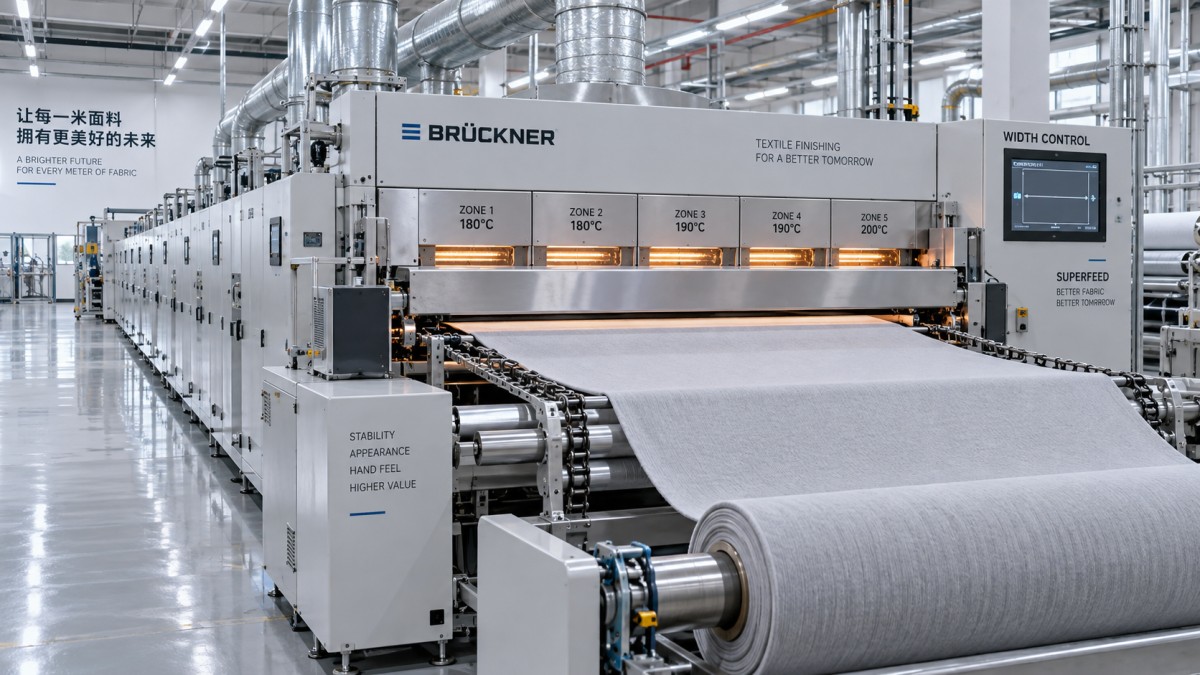
Temperature and dwell time determine how the dimensions are fixed
Heat does not create shrinkage control by itself. It changes how moisture is removed, how fibers relax, and how effectively the fabric configuration is stabilized. Temperature must be appropriate for fiber type, fabric weight, applied finish, residual moisture, and the required handle. A high temperature can improve setting on some synthetic or blended fabrics, but it may also make a natural-fiber fabric too dry, brittle in handle, or difficult to relax later.
Dwell time is equally important. A fabric moving too quickly through the chambers may leave with an acceptable surface dryness while its internal moisture distribution remains uneven. The outside may be over-dried and the center under-conditioned. Conversely, a long residence time at excessive temperature can over-fix a stretched condition and increase energy consumption without improving true wash stability.
Rather than changing every chamber at once, review the drying curve. Early chambers should remove free water without creating severe surface skinning. Middle chambers should continue drying uniformly, and the final zones should bring the fabric to the intended exit moisture and thermal condition. The exact profile depends on construction and finish chemistry, but the process principle remains the same: stable shrinkage needs uniform moisture removal, not maximum heat.
- When residual shrinkage is erratic from roll to roll, compare actual chamber temperatures with setpoints and inspect airflow balance.
- When the fabric feels harsh and shrinkage improves only slightly, reduce unnecessary thermal severity before increasing width tension.
- When elastic fabric shows poor recovery, confirm that heat exposure is compatible with the elastane-containing construction and any applied finish.
- When one side of the roll behaves differently from the other, inspect nozzle condition, recirculation balance, and cross-machine temperature uniformity.
Entry moisture and exit moisture are not secondary details
Moisture acts as a relaxation medium for many textile structures. Fabric entering too dry may resist width recovery and remain sensitive to mechanical tension. Fabric entering with unstable wet pickup may move differently through the pinning zone and dry unevenly across its width. In both cases, the stenter recipe can appear correct on paper while the fabric experiences different real conditions from meter to meter.
At the exit, the fabric should not be judged only by whether it feels dry enough to wind. Excessively low residual moisture can leave cellulosic fabrics with a brittle, boardy hand and may affect their ability to equilibrate before testing. Residual moisture that is too high can cause changes during cooling, batching, or storage. The aim is repeatable conditioning, particularly where the shrinkage test is sensitive to moisture regain and fabric relaxation.
Check the padder expression, wet pickup consistency, feed tension after the padder, and whether the fabric has time to spread before it enters the chain. A wet fabric that is being pulled unevenly can become dimensionally unstable before the first drying chamber has any opportunity to correct it.
Chain tension, pinning, and fabric path can quietly override the recipe
A recipe may call for positive overfeed, yet the intended relaxation can disappear if the fabric is under tension elsewhere. Guide rollers, expander systems, weft straighteners, padders, and exit winding all contribute to the real tension history. The chain itself also matters: excessive clip pressure can mark or restrain delicate fabric, while weak edge holding allows creep, skew, or width variation.
For pin stenters, assess pin penetration and fabric engagement. For clip stenters, inspect clip cleanliness, closing consistency, and wear. Edge damage is not only a quality issue; it changes how the fabric transfers tension from the chain into the body. A distorted or poorly held edge can make center measurements misleading.
Also examine the delivery section. A fabric that exits the last chamber in a relaxed state can be stretched again by an aggressive pull roll, high winding tension, or an unsuitable batching arrangement. When post-wash shrinkage rises unexpectedly, compare samples taken directly at stenter exit with samples taken after winding and conditioning. That comparison often shows whether the problem is created in the chambers or after them.
A practical adjustment sequence when shrinkage misses target
Changing temperature, width, and overfeed together makes the result difficult to interpret. Use a controlled sequence so that each adjustment has a clear purpose.
- Confirm the test condition. Use the agreed wash, drying, conditioning, and measurement method. Do not compare results from different test conditions as if they describe the same fabric behavior.
- Verify actual finished dimensions. Measure width, length behavior, skew, bow, weight, and appearance before deciding whether the shrinkage issue is lengthwise, widthwise, or both.
- Check tension before changing settings. Inspect feed path, pinning or clipping, delivery pull, and winding tension. A mechanical tension source can defeat a correct overfeed setting.
- Adjust overfeed first for machine-direction shrinkage. Make a modest change, then reassess shrinkage together with fabric appearance and length stability.
- Set width around the required relaxed construction. Avoid using excessive width stretch merely to achieve an immediate inspection measurement.
- Refine temperature and dwell time. Seek uniform drying and appropriate setting rather than the hottest or longest process.
- Review moisture consistency. Compare samples across the width and along the roll, especially if the results vary rather than simply miss target.
- Repeat after conditioning. Freshly finished fabric may continue to relax during cooling and storage. Testing only immediately after finishing can hide residual movement.
Different fabric families need different compromises
Cellulosic knits generally demand careful relaxation control. Overfeed, width setting, and post-stenter handling often have more visible influence than a small temperature increase. A compacted knit should not be re-extended on the stenter, or the benefit of compaction can be lost.
Woven cotton and cotton-rich fabrics may require controlled width stabilization while preserving construction balance. Too much lateral extension can change yarn spacing and create a fabric that looks correct before washing but contracts afterward. Heavier constructions may need enough dwell time for even moisture removal, yet extended heating should not be used as a substitute for managing mechanical tension.
Synthetic fabrics and blends can respond more strongly to thermal setting. Here, chamber temperature and dwell time may have a larger role, but overfeed and width tension still matter because the fabric can be heat-set in an undesired stretched geometry. Stretch fabrics require especially cautious control: dimensional stability, elastic recovery, surface quality, and heat exposure must be reviewed together rather than as separate targets.
The best stenter setting is therefore not the one that produces the lowest shrinkage number immediately after finishing. It is the setting combination that delivers the required width and appearance while allowing the fabric to retain a stable, repeatable structure through conditioning, washing, drying, and subsequent garment processing.
- Textile IoT Capital & EconomicsVDMA Opens ITMA 2027 Technical Delegation Pre-RegistrationVDMA opens ITMA 2027 technical delegation pre-registration. Explore German textile machinery, digital innovation and sustainability. Register interest by December 11, 2026.
- Fast Fashion & Agile MfgTextile OEM Compliance Evaluation: What to Check in a Supplier AuditTextile OEM compliance evaluation made practical: discover key supplier audit checks for quality, machinery, chemicals, traceability, and environmental risks.
- Textile IoT Capital & EconomicsTariffs and Inflation Weigh on Demand as U.S. Apparel Imports Fall to $56.68 BillionU.S. apparel imports fell 6.14% to $56.68 billion as tariffs and inflation weighed on demand. Explore what this could mean for buyers and exporters.
Related News
Get weekly intelligence in your inbox.
No noise. No sponsored content. Pure intelligence.
