




How can I reduce downtime on knitting machinery? In a mill running short production cycles, the question is rarely theoretical. A circular knitting machine stops during a color change, a computerized flat knitter begins dropping stitches halfway through a seamless garment, or a warp knitting line loses tension stability just as an urgent order is due to ship. The lost minutes quickly become lost capacity, rejected fabric, delayed cutting schedules, and an anxious production team trying to recover the day.
The most reliable answer is not simply “maintain the machine more often.” Lower downtime comes from treating knitting performance as a connected system: yarn preparation, machine condition, lubrication, settings, operator routines, spare-parts readiness, and production planning all affect one another. When these elements are managed as one operating discipline, mills can prevent many stops before they occur and shorten the ones that cannot be avoided.
Start by separating planned stops from avoidable losses
Not every machine stop is a failure. Style changes, gauge conversions, cleaning, needle replacement, programmed lubrication checks, and scheduled inspections are necessary parts of running a flexible knitting operation. The goal is not to eliminate all downtime; it is to reduce unplanned downtime and make planned downtime faster, safer, and more predictable.
A useful first step is to log every stop in categories that production and maintenance teams can both understand. Rather than recording “machine issue,” identify the actual event: yarn break, feeder fault, needle damage, sinker wear, oil contamination, pattern error, take-down instability, electrical alarm, compressed-air issue, or operator intervention. Include the duration, machine model, article being run, yarn lot, shift, and corrective action.
Within a few weeks, patterns usually emerge. One machine may repeatedly stop because a particular feeder is poorly aligned. Another may show frequent needle breakage only with a high-elastane yarn. A third may lose time during changeovers because settings are stored inconsistently. These are different problems, and they require different responses.
For plant managers, the important measure is not only total downtime. Track:
- Unplanned stoppage minutes per machine and per shift;
- Mean time between failures for recurring fault types;
- Mean time to repair, including waiting time for technicians or parts;
- First-pass fabric quality after restart;
- Changeover duration by product family; and
- Stops linked to yarn, environment, utilities, and operator handling.
This turns a frustrating stream of alarms into a practical improvement map. It also prevents a common mistake: replacing expensive components when the root cause is actually poor yarn conditioning, inadequate cleaning, or an unstable process setting.
Protect the knitting zone before defects become stoppages
In knitting, small mechanical imperfections can become large production interruptions. A worn latch needle, damaged sinker, rough guide, or misaligned feeder may first appear as a barely visible streak or occasional dropped stitch. If the warning is missed, the result can be a yarn break, a damaged cylinder area, a fabric defect roll, or an extended shutdown.
Preventive maintenance should therefore focus on the components that directly control yarn movement and loop formation. For circular knitting, this includes needles, sinkers, cams, feeders, yarn guides, cylinders, dial components, take-down rollers, positive feeders, lubrication circuits, and fan-assisted cleaning systems. For flat knitting, inspect needle beds, carriage tracks, yarn carriers, transfer mechanisms, racking movement, take-down combs, and electronic selection systems. Warp knitting lines demand equally close attention to guide bars, compound needles, latch elements, beam tension, let-off systems, and fabric take-up.
A good inspection routine is based on condition, not only calendar dates. High-speed machines running abrasive fibers, recycled yarns, metallic effects, high twist, or elastane blends may require closer inspection than machines producing stable basic constructions. Maintenance intervals should reflect the yarn, gauge, speed, ambient dust level, and actual fault history.
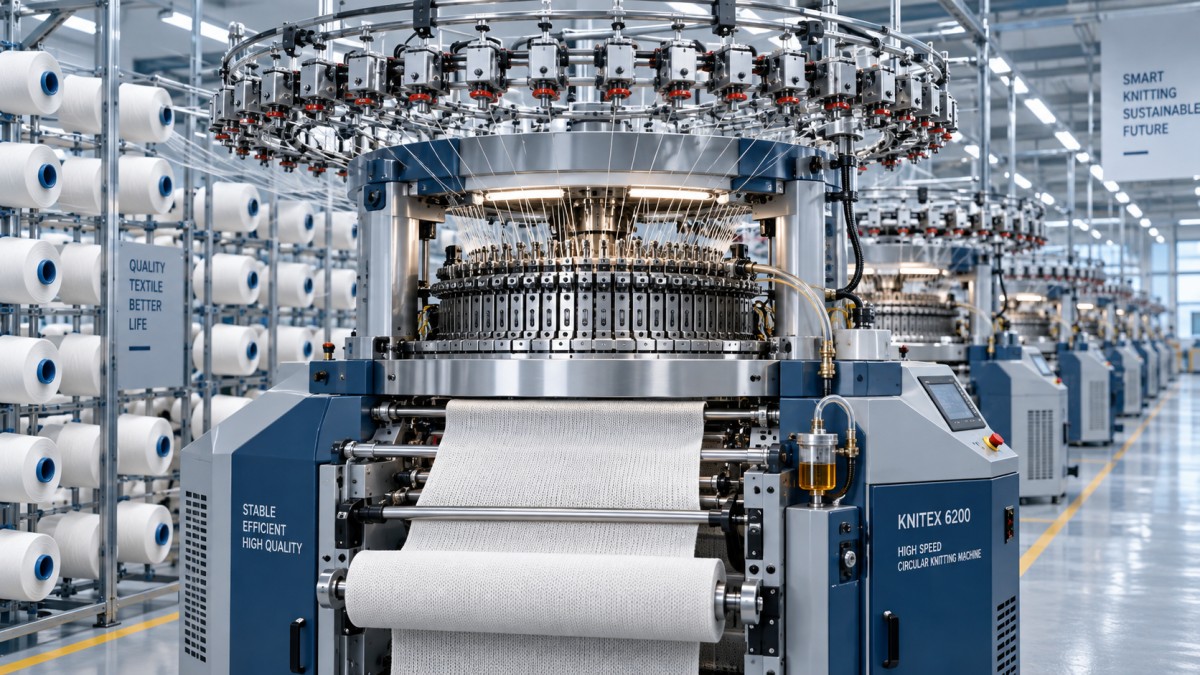
Cleaning deserves more respect than it often receives. Lint accumulation can interfere with sensors, airflow, electronic cabinets, lubricated surfaces, and yarn-path components. Yet aggressive cleaning with the wrong air pressure or tools can push contamination deeper into sensitive areas. Establish a defined cleaning method for each machine type, specify safe materials, and assign responsibility at shift handover. A clean machine also makes leaks, wear marks, loose fasteners, and abnormal vibration easier to detect early.
Make lubrication precise, not excessive
Improper lubrication causes two expensive outcomes: premature wear on one side and oil-stained fabric on the other. Both can create downtime, especially when a machine must be stopped for cleaning, component replacement, or quality investigation.
Verify that lubricant grade, delivery rate, distribution points, and automatic lubrication settings match the manufacturer’s guidance and the knitting application. Check lines and nozzles for blockage, leaks, or uneven distribution. Where machines use centralized systems, confirm that the controller is actually delivering oil rather than merely indicating that a cycle has been commanded.
Operators should be encouraged to report unusual oil marks immediately. Treat them as a process signal, not merely a fabric inspection issue. Oil contamination may indicate an over-lubricated element, a damaged seal, excessive buildup, or a faulty delivery point. Continuing to run in the hope that the marks disappear often converts a short intervention into a larger quality loss.
Yarn quality and yarn preparation are part of machine reliability
Many mills investigate knitting machinery first when they experience frequent breaks or uneven fabric. Sometimes that is correct. But a machine cannot run consistently when yarn moisture, package build, wax level, tension behavior, splice quality, or lot consistency is unstable.
Before blaming the knitting machine, compare stoppage records with yarn lot changes and supplier batches. Check whether package hardness is uniform, whether cone unwinding is smooth, and whether yarn has been stored in conditions appropriate for its fiber type. Cotton, viscose, wool blends, synthetics, and recycled fibers respond differently to humidity and static. An air-conditioned knitting floor with poor humidity control can create a persistent, hard-to-explain breakage pattern.
Yarn tension should be measured at meaningful points in the path, not judged only by visual observation. Positive feeders, tensioners, yarn brakes, guides, and creels must work together. Excess tension increases breakage and needle stress; insufficient or fluctuating tension can lead to loose loops, barre, and irregular stitch length. On machines producing engineered structures, seamless garments, or technical textiles, slight tension variation can have an outsized impact on product consistency.
For new yarns or unfamiliar blends, run a controlled trial before scheduling a large order. Record speed, feeder settings, yarn tension, break frequency, needle condition, and fabric appearance. That modest trial protects production from discovering compatibility issues after dozens of machines are already running.
Use machine data to catch drift while there is still time
Modern knitting equipment produces valuable operational signals: speed, stop reasons, yarn-break events, pattern alarms, feeder activity, drive load, temperature, energy use, and sometimes condition data from critical assemblies. The challenge is not collecting every available signal. It is deciding which signals reveal process drift early enough to act.
A practical dashboard may highlight machines with rising stop frequency, repeated faults at the same feeder position, unusually long restart times, abnormal motor load, or output below the planned rate. Maintenance personnel do not need another screen full of colors; they need a prioritized list of exceptions that points them toward the next useful inspection.
For example, if a specific circular knitting machine shows a growing number of yarn-break stops while speed and yarn lot remain unchanged, investigate feeder alignment, guide wear, tension variation, and machine cleanliness before the issue causes widespread defects. If a flat knitting machine repeatedly pauses at the same carriage location, review the needle bed, rail condition, carriage sensors, and program sequence together rather than replacing parts at random.
At ATFS, we see the strongest gains when machine monitoring is connected to production planning rather than treated as a maintenance-only project. A warning about rising fault risk should influence which order runs next, when a changeover is scheduled, and whether maintenance can be completed during a planned production gap. This is especially important for fast-fashion and small-batch manufacturing, where a short delay on one style can disrupt cutting, sewing, and dispatch downstream.
Reduce repair time with better fault-response design
Even a well-maintained knitting room will experience unexpected faults. What distinguishes a resilient operation is the speed and consistency of its response.
Create short fault-response standards for the most common stoppages. A yarn-break instruction, for instance, should define how to stop safely, inspect the yarn path, remove damaged loops if needed, check the needle and sinker area, restore the yarn, restart at an appropriate speed, and inspect the first meters of fabric. The procedure should be simple enough to use under production pressure but detailed enough to avoid repeated stops caused by incomplete correction.
Clarify the boundary between operator actions and technician actions. Operators should be trained to recognize early warning signs, perform approved cleaning, replace designated consumables, and report accurate fault information. They should not be forced to improvise repairs beyond their competence. Conversely, technicians should receive useful evidence—not a vague message that the machine “keeps stopping.”
Keep critical spares close to the knitting floor and organize them by machine family. Needles, sinkers, yarn guides, sensors, belts, fuses, feeder components, lubrication fittings, and approved cleaning materials often prevent a small fault from becoming a long wait. Spare-parts strategy should be informed by failure history and lead time, not by indiscriminate stockpiling.
Shorten changeovers without creating the next breakdown
Frequent style changes are now normal for many apparel and technical-textile producers. The temptation is to rush setup, skip verification, and recover time through higher running speed. That approach often creates a false economy: a fast changeover followed by unstable knitting, defective fabric, or repeated adjustment stops.
Instead, build standardized setup recipes for repeatable product families. Document needle selection, stitch length, yarn path, feeder configuration, take-down settings, speed limits, pattern files, lubrication checks, and quality checkpoints. For computerized flat knitting, maintain clear version control for programs so an outdated file does not reach the machine. For warp knitting, ensure beam, guide-bar, and tension settings are recorded in a form that the next shift can use without interpretation.
Where possible, prepare yarn packages, tools, patterns, and approved settings before the current order ends. This “externalizes” work that would otherwise occur while the machine is idle. But always retain a first-piece or first-roll validation step. Running the wrong construction at full speed is not agility.
Do not overlook utilities and the production environment
Knitting machinery depends on stable power, compressed air where applicable, temperature, humidity, and clean surroundings. Voltage fluctuations can trigger drive and control faults. Poor air quality affects pneumatic systems and cleaning performance. Excessive heat can shorten electronic component life, while low humidity may increase static-related yarn problems.
Review utility alarms alongside machine alarms. If several machines show unrelated faults during the same time window, look upstream at power quality, compressed-air pressure, HVAC performance, or network reliability. A maintenance team can spend hours chasing individual machine symptoms when the actual cause is shared infrastructure.
Build a culture where restart quality matters
The pressure to restart quickly is understandable, but the fastest button press is not always the fastest recovery. A restart that produces faulty fabric, repeats the same breakage, or damages components creates more downtime later. Measure successful recovery as “machine running stably at approved quality,” not simply “machine moving again.”
Brief shift reviews can be remarkably effective. Discuss the longest stops, repeated faults, defect observations, and near misses while details are fresh. Invite operators to contribute; they often notice changes in sound, vibration, yarn behavior, or fabric feel before a formal alarm appears. Their observations become far more valuable when they are captured in a consistent reporting system.
Ultimately, reducing downtime on knitting machinery is a continuous discipline rather than a one-time maintenance campaign. Maintain the loop-forming zone carefully, control yarn and environmental conditions, use data to identify drift, prepare teams for common faults, and plan changeovers with the next run in mind. The reward is not just more machine hours. It is steadier fabric quality, calmer production teams, and a knitting operation better able to meet the modern demand for speed, variety, and dependable delivery.
- Textile IoT Capital & EconomicsVDMA Opens ITMA 2027 Technical Delegation Pre-RegistrationVDMA opens ITMA 2027 technical delegation pre-registration. Explore German textile machinery, digital innovation and sustainability. Register interest by December 11, 2026.
- Fast Fashion & Agile MfgTextile OEM Compliance Evaluation: What to Check in a Supplier AuditTextile OEM compliance evaluation made practical: discover key supplier audit checks for quality, machinery, chemicals, traceability, and environmental risks.
- Textile IoT Capital & EconomicsTariffs and Inflation Weigh on Demand as U.S. Apparel Imports Fall to $56.68 BillionU.S. apparel imports fell 6.14% to $56.68 billion as tariffs and inflation weighed on demand. Explore what this could mean for buyers and exporters.
Related News
Get weekly intelligence in your inbox.
No noise. No sponsored content. Pure intelligence.
