




3D knitting can be highly suitable for seamless sportswear production, but it is not automatically the right answer for every activewear program. It works best when comfort, body-mapped support, stretch control, and reduced cut-and-sew assembly are central to the product. It is less suitable when a design depends on sharp tailoring, heavy structural components, highly complex surface graphics, or very large runs of a simple, stable style.
The practical question is not simply whether a garment can be knitted in three dimensions. It is whether the selected machine, yarn system, garment construction, and production plan can deliver the intended fit and performance consistently. A seamless sports bra, compression top, base layer, or fitted training legging can benefit substantially from 3D knitting. A loose woven running shell or a heavily paneled protective garment usually requires a different manufacturing route.
What 3D knitting changes in seamless sportswear
Traditional sportswear production normally starts with fabric rolls. Pattern pieces are cut, joined with stitching, then finished with elastics, labels, bindings, and other components. The garment performance depends on the fabric, the pattern, and the quality of every sewn connection.
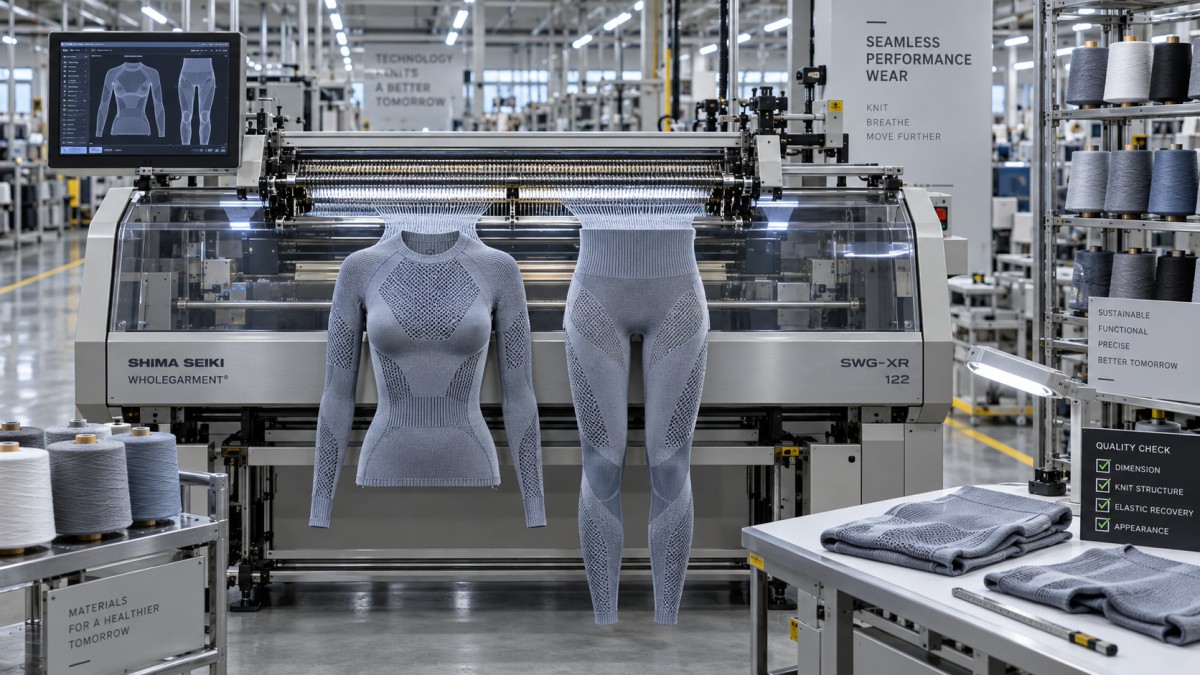
3D knitting approaches the product from another direction. A computerized knitting machine controls yarn movement, stitch density, knit structure, and shaped areas while the garment is being formed. Instead of cutting multiple flat panels from fabric, the machine can create a near-complete tubular or shaped garment with integrated zones for ventilation, support, stretch, or texture.
“Seamless” should be understood carefully. It usually means the garment has far fewer conventional sewn seams, particularly around the torso. It does not always mean that no secondary operation is needed. Sports bras may still need pads, closures, straps, elastic finishing, or reinforcement. Leggings may need a waistband treatment, gusset refinement, or branding application. The value lies in reducing the seams that create bulk, rubbing, assembly time, and material offcuts.
For close-fitting sportswear, this production method can make a visible difference in how the product feels during movement. A seam that appears harmless on a mannequin can become a pressure point during running, cycling, yoga, or high-repetition training. Integrating support and stretch zones into the knit structure gives designers more control over where the garment holds, flexes, breathes, and recovers.
Where seamless 3D knitting is a strong fit
The best use cases are garments that sit close to the body and need to move with it. In these categories, conventional seams often create a functional limitation rather than merely an aesthetic one.
- Sports bras and crop tops: Zoned compression can provide support around the underbust and side body, while more open structures can improve airflow across higher-heat areas. The design still needs careful evaluation for the activity level and intended cup support.
- Compression tops and base layers: These products benefit from a smooth inner surface, controlled stretch, and fewer seam interruptions. Rib structures, mesh zones, and denser knit areas can be integrated without adding separate panels.
- Yoga, studio, and low-impact activewear: Soft hand feel and freedom of movement are often more important than rigid shaping. Seamless constructions can support a clean silhouette with minimal bulk.
- Training leggings and shorts: Knitted body-contouring areas, breathable zones, and reduced seam placement can improve comfort. The waistband, opacity under stretch, and abrasion resistance still need product-specific testing.
- Adaptive and inclusive activewear: Fewer internal seams may be useful for people who are sensitive to pressure or surface irritation. However, easy dressing, grip, closure design, and fit accessibility should be considered separately rather than assumed to be solved by seamless knitting alone.
The technique is especially valuable when a single garment needs several material behaviors. For example, a training top may require a stable lower hem, flexible shoulder movement, denser support around the torso, and breathable zones along the back. With cut-and-sew construction, those needs may require several fabrics and stitched panels. With engineered knitting, they can sometimes be achieved through stitch architecture and yarn placement within one garment body.
Do not confuse “seamless” with “one yarn, one process”
A common mistake is assuming that a seamless garment is simpler to develop because it has fewer sewing operations. In production, the work shifts upstream into knit programming, yarn selection, fit development, and finishing control.
A well-made seamless garment depends on the interaction between yarn and structure. A yarn that feels soft may not provide enough recovery for a compression zone. A highly elastic yarn may improve support but make the garment harder to stabilize, dye, or size consistently. Moisture-management claims also cannot be judged by fiber name alone. They depend on yarn design, knit openness, surface treatment, garment fit, and the conditions in which the wearer uses the product.
Stitch density matters just as much. A denser structure may offer greater hold and opacity, but it can also reduce breathability and make the garment feel warmer. An open mesh zone can improve ventilation, yet it may snag more easily or become visually transparent when stretched. These are not defects in 3D knitting; they are design tradeoffs that should be planned by activity, body location, and expected wear conditions.
Garment finishing remains important. Scouring, dyeing, washing, heat setting, drying, and quality inspection can affect dimensions, stretch recovery, color uniformity, and hand feel. A prototype that looks correct immediately after knitting may change after wet processing. Product development should therefore evaluate finished garments, not only machine-off samples.
A practical way to decide before committing
Rather than beginning with a machine specification or a visual trend, start with the garment’s performance brief. The following sequence helps identify whether seamless 3D knitting is a sensible manufacturing route.
- Define the movement and support requirement. Identify whether the garment is intended for low-impact studio work, running, gym training, outdoor layering, or recovery use. A light yoga bra and a high-support running bra may both be seamless, but their construction requirements are very different.
- Map pressure, friction, and heat zones. Consider where the body needs compression, where it flexes, where perspiration accumulates, and where seams may rub. This turns a general comfort claim into a usable knit engineering brief.
- Decide what must be integrated. Support zones, mesh areas, ribbing, shaping, texture, and branding can often be knitted in. Molded cups, zippers, hardware, bonded pockets, and highly rigid reinforcement may require additional processes.
- Choose yarns for the job, not for a label claim. Assess stretch, recovery, softness, durability, dye response, heat sensitivity, and compatibility with the intended knit structure. A successful yarn choice supports both wear performance and stable production.
- Review the size architecture early. Seamless garments can be forgiving in some fit areas because of their stretch, but this does not eliminate grading work. Excessive reliance on stretch can create inconsistent support between sizes.
- Validate the production economics. Compare total process cost, not just knitting time. Include programming, sampling iterations, finishing, secondary assembly, inspection, material use, changeovers, and expected order volume.
This process exposes an important distinction: 3D knitting reduces certain kinds of complexity while increasing others. It can remove cutting waste and a significant amount of seam assembly, but it asks more from technical product development. Brands that treat it as a direct replacement for ordinary jersey cut-and-sew often encounter avoidable delays.
Machine capability determines the design boundary
Not every knitting platform produces the same result. Circular seamless knitting systems are commonly used for close-fitting tubular apparel such as bras, tops, leggings, and underwear-inspired activewear. They are efficient for recurring bodywear programs and can create localized structures around the garment circumference.
Computerized flat knitting offers another route, particularly where more complex shaping, engineered panels, or integral details are required. It can form highly shaped knitted components and may be useful for garments that need more architectural construction. However, the viable product shape, production rate, finishing route, and assembly requirements depend on the specific machine configuration and knit program.
Machine selection should follow the product, rather than forcing the product into the capability of available equipment. Questions worth asking include whether the machine can produce the desired gauge, accommodate the selected yarn package, form the necessary support structure, control stitch variation reliably, and deliver the required garment dimensions after finishing.
For manufacturers evaluating broader textile equipment decisions, the same principle applies across the line. A knitting program is affected by downstream dyeing and finishing behavior, while a cut-and-sew program is affected by fabric yield and automated cutting accuracy. ATFS tracks these connected manufacturing decisions because fast response depends on the full production chain, not on a single machine category in isolation.
When cut-and-sew may be the better option
3D knitting is not a universal upgrade. Cut-and-sew remains practical when the garment needs distinct fabric types that cannot reasonably be recreated through knitted structures. A trail-running shell may need a waterproof membrane, taped seams, woven abrasion panels, and adjustable hardware. A team uniform may require large, exact graphic placements across multiple fabric panels. A protective garment may need reinforcements that are unsuitable for an all-knitted construction.
It can also be the more efficient route for a simple, proven style produced at a scale where fabric sourcing, pattern cutting, and sewing are already optimized. If the product does not gain comfort, performance, waste reduction, or design differentiation from seamless construction, changing the production method may only add development effort.
Production risks that should be addressed during sampling
The most costly mistakes often appear after a visually successful first sample. A garment can look premium on a hanger but lose opacity when stretched, roll at the hem, distort after finishing, or provide uneven compression across sizes. Sampling should reflect real use rather than only visual approval.
Check the garment on moving bodies, not only static fit forms. Evaluate arm lift, deep bending, running motion, repeated stretch, and contact points under straps or equipment. For bras, support needs to be assessed at the intended activity level rather than inferred from fabric thickness. For leggings, squat opacity and waistband stability may matter more than the initial hand feel.
Also inspect transitions between knit zones. A sudden change from dense compression knit to open mesh can create a visible line, a tension difference, or a weak point if it is not engineered carefully. The goal is not to add as many zones as possible. It is to use each zone where it contributes to fit, comfort, or function.
Color and finishing should be included in the development loop. Dark shades, bright shades, heather effects, and yarn blends can behave differently through dyeing and heat setting. When sustainability targets are part of the brief, assess the complete route: yarn selection, reduced cutting waste, water and energy requirements in wet processing, and durability over the garment’s useful life.
Start with a focused product instead of an entire collection
A controlled first program usually provides more useful learning than converting every activewear category at once. Choose a garment where seamless construction has a clear reason to exist: a medium-support sports bra, fitted training top, compression base layer, or performance legging with targeted ventilation. Build the brief around a specific wearer and movement profile, then compare the finished result against a conventional alternative.
That comparison should cover fit consistency, comfort in motion, recovery after wear and wash, visual quality, secondary assembly needs, and manufacturing workflow. The decision becomes clearer when 3D knitting is evaluated as a complete garment system rather than as a novelty or a simple way to remove seams.
For the right sportswear category, 3D knitting can create a more integrated product with less cutting loss and fewer friction points. Its value is strongest when the development team treats knit structure, yarn behavior, finishing, and intended activity as one connected design problem.
- Textile IoT Capital & EconomicsVDMA Opens ITMA 2027 Technical Delegation Pre-RegistrationVDMA opens ITMA 2027 technical delegation pre-registration. Explore German textile machinery, digital innovation and sustainability. Register interest by December 11, 2026.
- Fast Fashion & Agile MfgTextile OEM Compliance Evaluation: What to Check in a Supplier AuditTextile OEM compliance evaluation made practical: discover key supplier audit checks for quality, machinery, chemicals, traceability, and environmental risks.
- Textile IoT Capital & EconomicsTariffs and Inflation Weigh on Demand as U.S. Apparel Imports Fall to $56.68 BillionU.S. apparel imports fell 6.14% to $56.68 billion as tariffs and inflation weighed on demand. Explore what this could mean for buyers and exporters.
Related News
Get weekly intelligence in your inbox.
No noise. No sponsored content. Pure intelligence.
