




A design team may need a fabric that stays stable under load, follows a complex contour, and can be produced without the slow cycle times associated with weaving or hand-laid reinforcement. At that point, the question is not simply whether a fabric can be knitted. It is whether its structure can control elongation, manage yarn orientation, survive downstream processing, and perform predictably in the finished component.
Are warp knitting machines suitable for technical textiles? In many cases, yes. They are especially suitable when the application benefits from high production speed, controlled open or closed structures, low fabric distortion, engineered stretch, or precise placement of reinforcement yarns. However, warp knitting is not a universal replacement for woven, braided, nonwoven, or conventional composite processes. The correct choice depends on load direction, fiber type, end-use environment, required dimensional stability, and the degree of structure the machine must create.
Where warp knitting delivers technical value
Warp knitting forms loops from many parallel yarns, usually fed from a warp beam. Unlike weft knitting, where one yarn travels across the fabric width, warp-knit construction can produce relatively stable structures at high speed. That stability is one reason the technology appears in technical applications where ordinary knitwear would be too extensible or too easily distorted.
The strongest fit is often an application where fabric behavior must be engineered rather than merely decorative. A mesh for a medical support, a spacer fabric for vehicle seating, a reinforcement layer for a composite panel, or a durable sports fabric may each require a different balance of openness, thickness, stretch, abrasion resistance, and directional strength. Warp knitting allows the producer to influence these properties through stitch pattern, guide-bar movement, yarn selection, inlay yarns, and finishing.
- Automotive interiors: spacer fabrics, seat coverings, headliners, air-management textiles, and backing layers can benefit from controlled thickness and breathability.
- Medical and hygiene products: bandage structures, support fabrics, breathable meshes, and selected implant-related textile constructions may require consistent porosity and soft contact behavior.
- Sports and performance apparel: lightweight mesh, compression zones, durable stretch panels, and shoe-textile components can be produced with localized functional properties.
- Industrial filtration and separation: open structures can be designed around pore geometry, chemical compatibility, and strength requirements.
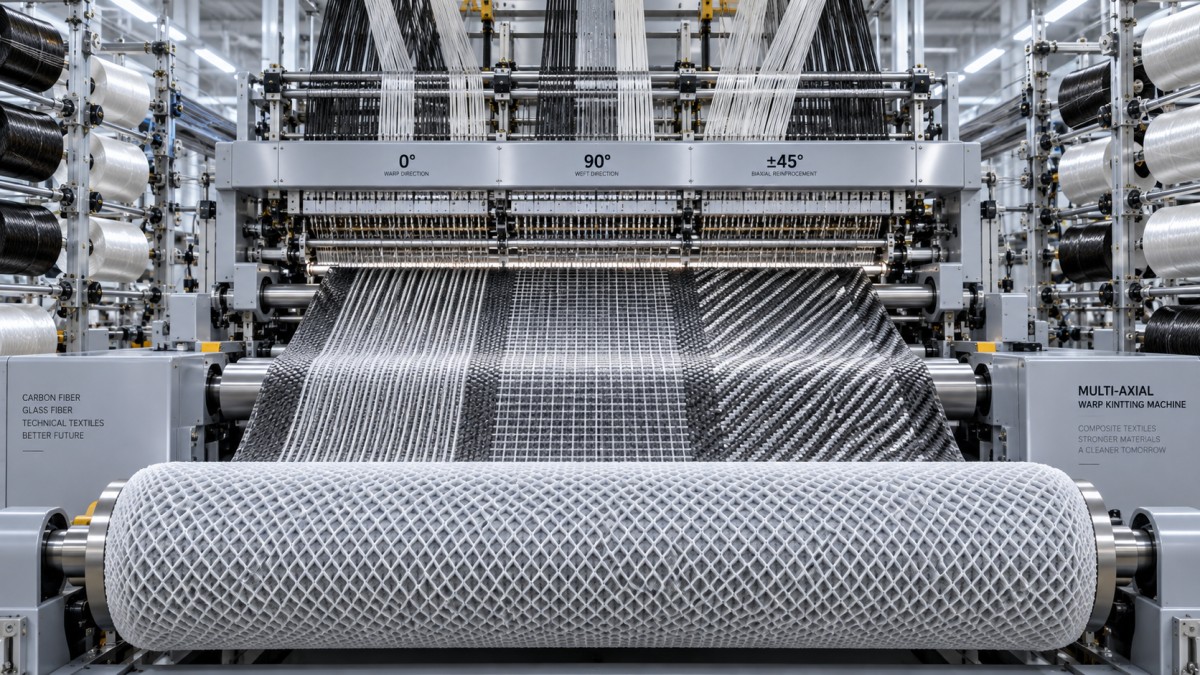
- Composite reinforcement: multi-axial warp-knit structures can hold straight reinforcement yarns in selected orientations before resin infusion or other consolidation processes.
- Geotextile and construction uses: certain stable mesh and reinforcement constructions are suited to applications where tensile behavior and installation handling matter.
The important distinction is that technical suitability comes from the engineered construction, not from the label “warp knit.” A lightweight polyester tricot and a multi-axial carbon-fiber reinforcement may both be produced on warp-knitting equipment, but they solve entirely different performance problems.
The first decision: define what the textile must do under stress
A common purchasing mistake is to start with machine speed or fabric appearance. Those are relevant, but they should come after the functional brief. Technical textiles fail less often because they look wrong and more often because the material moves, deforms, delaminates, clogs, abrades, or loses strength in a direction that was not properly evaluated.
Before selecting a warp knitting route, define the working condition in practical terms. Is the material loaded mainly in one direction, in two directions, or at several angles? Does it need controlled stretch for fit or compression? Will it face cyclic loading, heat, moisture, chemicals, ultraviolet exposure, puncture, or repeated bending? Does it need airflow, fluid flow, insulation, cushioning, or a surface suitable for coating and lamination?
These questions determine whether a looped structure is advantageous. Loop formation gives warp knits flexibility and process efficiency, yet loops can also introduce extensibility. In some structures, that is desirable. In others, it must be constrained with inlay yarns, stitch design, coating, bonding, or a different reinforcement architecture.
When stretch is useful rather than a defect
Compression textiles, orthopedic supports, footwear uppers, transport seating, and protective apparel often need a controlled degree of extension. A warp-knit construction can deliver stretch in a preferred direction while retaining more stability in another. The design challenge is to avoid treating “elastic” as a single property. Extension, recovery, hysteresis, force at a defined elongation, and fatigue after repeated cycles should be assessed separately.
For example, adding elastomeric yarn may produce the initial stretch required for fit, but the fabric also needs to recover after use and retain its structure after finishing, laundering, heat exposure, or lamination. The yarn path, stitch density, tension settings, and heat-setting process can all alter that result.
When dimensional stability is the priority
Composite reinforcements, industrial scrims, filters, and structural laminates frequently demand much lower deformation. In these cases, inlay warp knitting and multi-axial warp knitting are often more relevant than highly looped apparel-style structures. Straight or nearly straight yarns can be laid at selected angles and held together by a knitting thread. The binding yarn maintains the preform while the reinforcement fibers carry the primary load.
This approach is particularly useful when the finished part needs fibers at 0°, 90°, or diagonal orientations. A conventional woven fabric naturally introduces yarn crimp at interlacing points. By comparison, a multi-axial warp-knit reinforcement can preserve straighter load-bearing fibers, which may be useful where efficient force transfer is important after consolidation. The actual performance still depends on fiber selection, areal weight, resin system, fiber volume fraction, consolidation quality, and part geometry.
Choose the machine family according to the structure, not the broad application name
Technical textile requirements can point to very different warp-knitting machine configurations. Using “technical textile” as the only specification is too vague for a machine decision. The fabric architecture should lead the conversation.
Machine width, gauge, number of guide bars, yarn feeding capability, pattern control, take-down stability, and compatibility with reinforcement fibers all affect the feasible structure. A machine that is excellent for soft, fine-gauge apparel fabric may not handle heavy glass, aramid, basalt, or carbon yarns in the manner required for a structural preform.
Material behavior can limit the machine more than the pattern does
Technical yarns do not always run like standard filament polyester or nylon. Carbon fiber can be sensitive to handling damage and tension variation. Glass fiber may be abrasive. Aramid can present cutting and processing challenges. High-modulus yarns may have limited tolerance for sharp yarn-path changes, excessive friction, or unsuitable tension control. Coated yarns may create buildup on guides, while monofilaments can behave differently from multifilament yarns during loop formation.
That is why a fabric drawing alone is not enough. The development stage should examine whether the yarn can travel through the required guides, whether the tension range is stable, and whether the knitting action creates filament breakage, fuzz, loop irregularity, or unacceptable variation in fabric weight. These issues can become more visible at production speed than during a short sampling run.
Downstream operations must also be considered early. A fabric may knit cleanly but react poorly to coating, heat setting, dyeing, resin impregnation, ultrasonic cutting, sewing, welding, or lamination. For a composite reinforcement, fabric drape and permeability can strongly affect resin flow. For a spacer textile, compression recovery may change after lamination. For a filter medium, a finishing step can alter pore size more than expected.
A practical way to evaluate feasibility before investing
Instead of asking whether warp knitting is generally appropriate, convert the requirement into a staged feasibility review. This prevents a technically impressive machine from being selected for a fabric architecture that does not match the final component.
- Map the end-use forces. Identify tensile direction, shear exposure, compression, abrasion, flexing, impact, or fluid pressure. A simple diagram of where the component is loaded is often more useful than an early machine specification.
- Separate essential properties from preferences. Required strength, elongation limits, thickness, weight, porosity, thermal behavior, and chemical resistance should be distinguished from cosmetic preferences such as surface appearance or color.
- Select candidate yarn systems. Compare polymer, glass, carbon, aramid, or hybrid yarns based on the environment and processing route. Include yarn count, twist, coating, friction behavior, and availability in the review.
- Define the fabric architecture. Decide whether the textile needs loops, inlaid yarns, two faces separated by pile yarns, open mesh, or multi-directional reinforcement layers.
- Run representative trials. Trials should use intended yarns and meaningful operating conditions. Evaluate both machine running behavior and post-process performance rather than judging only the fabric immediately after knitting.
- Test the finished material state. Assess the material after coating, curing, washing, thermal treatment, or composite consolidation, because that is the form exposed to actual service conditions.
This sequence also helps distinguish a machine issue from a material-design issue. Uneven width, unstable loops, inconsistent density, and frequent yarn breaks may indicate tension, guide, yarn-path, or take-down problems. By contrast, adequate knitting quality combined with insufficient finished strength often points back to fiber orientation, yarn selection, stitch geometry, or the need for a different construction.
Situations where another textile process may be better
Warp knitting should not be chosen simply because it is fast. A tightly woven structure may be more appropriate where very low air permeability, strong edge stability, or balanced performance in warp and weft is required. Braiding can be a better fit for tubular components, hoses, sleeves, and complex preforms where fibers must follow a three-dimensional path. Nonwovens may be preferable for disposable filtration, insulation, absorbency, or cost-sensitive bulk layers. Conventional unidirectional reinforcement can be more efficient when almost all load is known to occur in one direction.
Very heavy reinforcement packages, unusually thick structures, or highly specialized fiber angles may also exceed the practical range of a particular knitting configuration. In those cases, the right answer may be a hybrid construction: a warp-knit carrier fabric combined with woven layers, nonwoven webs, films, coatings, or stitched reinforcement. The decision should follow the component’s failure mode rather than a preference for one manufacturing method.
Watch for these warning signs during development
A promising sample can conceal issues that appear later in use. Fabric curling, excessive skew, unstable width, visible barré, yarn damage, inconsistent porosity, or poor recovery after compression should not be treated as minor cosmetic defects in a technical application. Each can signal structural variation that affects functional performance.
For reinforcement fabrics, inspect whether the intended yarn angles remain consistent across the width and after handling. For spacer products, examine whether the two faces remain aligned and whether pile yarns buckle permanently under expected compression. For elastic technical fabrics, measure force and recovery after relevant conditioning rather than relying on hand feel. For porous structures, evaluate pore consistency after all finishing operations, not only in the greige state.
The most reliable investment decision comes when machine capability, yarn behavior, fabric structure, and downstream conversion have been assessed together. Warp knitting machines are highly suitable for technical textiles when the application needs their particular strengths: rapid production, engineered geometry, controlled stretch, stable mesh formation, three-dimensional spacer construction, or multi-axial fiber placement. When the required structure conflicts with loop-based mechanics or machine handling limits, another process—or a hybrid textile system—will provide a more dependable route.
- Textile IoT Capital & EconomicsVDMA Opens ITMA 2027 Technical Delegation Pre-RegistrationVDMA opens ITMA 2027 technical delegation pre-registration. Explore German textile machinery, digital innovation and sustainability. Register interest by December 11, 2026.
- Fast Fashion & Agile MfgTextile OEM Compliance Evaluation: What to Check in a Supplier AuditTextile OEM compliance evaluation made practical: discover key supplier audit checks for quality, machinery, chemicals, traceability, and environmental risks.
- Textile IoT Capital & EconomicsTariffs and Inflation Weigh on Demand as U.S. Apparel Imports Fall to $56.68 BillionU.S. apparel imports fell 6.14% to $56.68 billion as tariffs and inflation weighed on demand. Explore what this could mean for buyers and exporters.
Related News
Get weekly intelligence in your inbox.
No noise. No sponsored content. Pure intelligence.
