




Multi-axial warp knitting is increasingly suited to technical fabric production when a conventional woven or unidirectional reinforcement no longer provides the required balance of strength, drape, thickness control, and manufacturing speed. The technology is particularly relevant when a component must carry loads along several planned directions rather than mainly along warp and weft.
For technical evaluators, the question is rarely “Can this machine run carbon fiber?” The more useful question is: Can a multiaxial non-crimp fabric architecture deliver the target mechanical behavior while fitting the downstream process, quality window, and economics of the finished part? That distinction matters. A fabric may look impressive on a specification sheet yet create avoidable waste, resin-flow problems, distortion during preforming, or inconsistent laminate performance on the production floor.
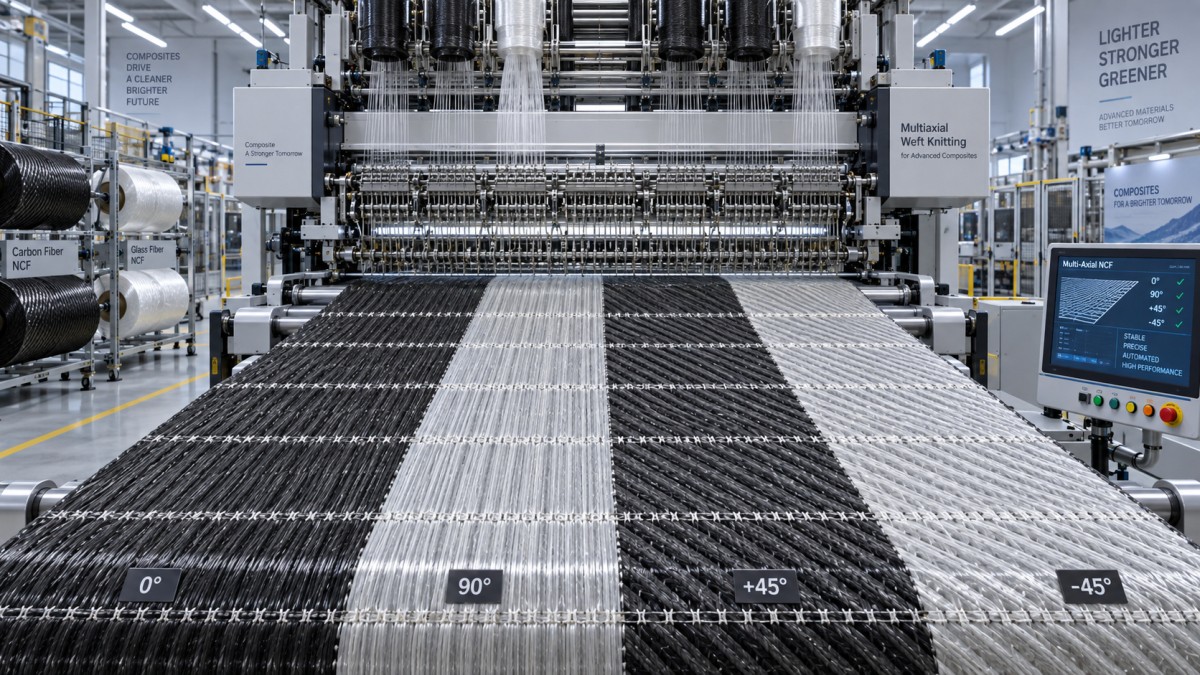
Multi-axial warp knitting answers a specific structural need. It places yarn layers at controlled angles—commonly 0°, 90°, +45°, and -45°—then lightly binds them together with a knitting yarn. The reinforcing fibers remain comparatively straight rather than being repeatedly interlaced as they are in a woven construction. This “non-crimp” arrangement can preserve more of the fiber’s tensile contribution and lets engineers build reinforcement around expected load paths.
The structural problem it solves
Many technical products face multidirectional stress, not a simple pull in one direction. A wind turbine blade shell experiences bending, torsion, shear, and fatigue over years of operation. An automotive structural panel may need stiffness for impact management but also enough formability to fit a complex mold. A marine laminate must resist cyclic loading and environmental exposure without becoming unnecessarily heavy.
In these situations, a fabric based only on 0°/90° woven yarns can require extra plies to achieve off-axis shear performance. Stacking separate unidirectional layers may improve directional design freedom, but it adds handling steps and introduces more opportunities for ply misalignment. Multi-axial warp-knitted fabrics consolidate several reinforcement orientations into one textile. The result is not automatically the best answer, but it is often a more practical one where repeatable layup architecture is central to part performance.
This is why the technology has established a strong position in fiber-reinforced composites, while also finding roles in coated technical textiles, load-bearing industrial fabrics, and engineered preforms. It is most valuable when the textile should behave less like a surface material and more like a deliberately designed structural skeleton.
Where multi-axial warp knitting is a strong fit
Large composite structures are among the clearest applications. Wind energy components, boat hulls, rail interiors, construction profiles, and industrial tanks benefit from broad fabric widths, stable reinforcement orientation, and efficient placement of glass or carbon fiber. For large parts, reducing the number of separate plies can simplify material handling and lower the risk that a manually assembled layup drifts away from its intended fiber angles.
Transportation components are another natural fit, especially where lightweighting must be balanced against predictable production. Multi-axial fabrics can be engineered for floor panels, battery enclosures, interior structures, body panels, leaf springs, and impact-oriented parts. The relevant value is not simply lower mass. It is the ability to put fiber where the structural model says it is needed, rather than using an isotropic or overly heavy textile as a compromise.
Sports, marine, and protective applications also benefit where stiffness-to-weight ratio or controlled flexibility matters. Skis, boards, helmets, pressure vessels, sporting frames, and advanced luggage shells may use biaxial, triaxial, or quadraxial reinforcements. In these cases, the technical team should assess whether the fabric’s low-crimp construction improves the final composite enough to justify the selected resin system, cutting method, and preform process.
Hybrid reinforcement systems deserve special attention. A producer may combine carbon fiber for stiffness, glass fiber for cost management, aramid for toughness, or thermoplastic yarns for later consolidation. Multi-axial warp knitting provides a platform for joining these layers into a manageable textile package. However, a hybrid fabric is not merely a blend of favorable properties. Differences in elongation, wet-out behavior, thermal expansion, and cutting response need to be evaluated early.
It is not just an alternative to weaving
Comparing a multiaxial non-crimp fabric with a woven fabric only by areal weight or fiber content can lead to poor decisions. Woven structures gain integrity through yarn interlacement, but the yarn path includes undulation, often called crimp. For applications that prioritize surface appearance, abrasion behavior, dimensional stability in two principal directions, or a familiar drape profile, weaving may remain the more appropriate route.
Multi-axial warp knitting takes a different approach. The reinforcement layers are laid in position and held by a stitch structure, often using polyester or another compatible binding yarn. Because the load-bearing yarns are not forced to travel over and under crossing yarns in the same way, the fabric can offer efficient load transfer along designed orientations. It can also be produced in wide formats and with layered architectures that would be cumbersome to create through conventional weaving.
The trade-off is that technical teams must pay close attention to stitch effects, fabric handling, edge stability, and the interaction between the binder yarn and the matrix. A fabric that is ideal for resin infusion may not behave equally well in compression molding or thermoplastic consolidation. “Non-crimp” should therefore be treated as a structural description, not as a universal performance guarantee.
Material selection starts with the process, not the fiber brochure
Carbon fiber is often the first material associated with advanced multi-axial warp knitting because of its high stiffness and low weight. It is well suited to aerospace-adjacent structures, performance automotive parts, wind-energy reinforcements, and sporting goods. Yet carbon’s handling sensitivity and cost mean that waste control, nesting accuracy, and cut-edge management become commercially important.
Glass fiber remains a major choice for technical fabric production due to its balance of mechanical properties, availability, and cost. E-glass is common in marine, construction, transport, and wind applications. Specialty glass grades may be considered where corrosion resistance, dielectric performance, or higher strength is relevant.
Aramid can bring impact resistance and toughness, although its cutting behavior and resin compatibility require careful planning. Basalt, flax, and other natural or mineral fibers may be selected for niche performance or sustainability objectives, but they should be tested under real processing conditions rather than judged only by laboratory tensile data. Natural fibers, for example, can introduce moisture-management and consistency considerations that affect composite quality.
The binding yarn deserves equal scrutiny. Its role is to stabilize the reinforcement architecture, but it can influence permeability, surface quality, drape, and compatibility with the final matrix. In some laminates, the stitch yarn’s local effect is negligible; in others, it can influence resin-rich zones or through-thickness behavior. The right evaluation includes the complete fabric-resin-process combination.
A practical evaluation sequence for technical teams
Before specifying machinery or fabric architecture, begin with the part rather than the textile. Map the primary tensile, compressive, shear, impact, and fatigue loads. Then identify where load directions change across the geometry. A simple flat panel may need only a biaxial fabric, while a torsionally loaded shell could justify a more complex arrangement of 0°, 90°, and ±45° layers.
- Define the reinforcement map. Determine fiber orientations, target areal weight, thickness limits, local reinforcements, and permitted tolerances. Do not assume that a symmetric quadraxial construction is necessary merely because it is widely available.
- Match the fabric to the forming route. Vacuum infusion, resin transfer molding, prepreg processing, compression molding, and thermoplastic consolidation impose different demands on permeability, drape, tack, and dimensional stability.
- Test deformation before committing. Trial the fabric around radii, corners, openings, and variable-depth features. Wrinkling, layer shifting, or local fiber distortion can erase the theoretical benefit of an optimized angle layout.
- Validate the finished laminate. Evaluate fiber volume fraction, void content, tensile and flexural response, interlaminar behavior, fatigue where relevant, and visual defects. Fabric-level data alone cannot predict final-part performance.
- Review conversion losses. Include slitting, cutting, kitting, scrap from orientation constraints, and operator handling. For expensive carbon architectures, material utilization can influence the business case as strongly as loom output.
This sequence is especially useful for organizations moving from prototype composites to repeatable series production. The fabric may be technically sound, yet the program can still struggle if the cutting line cannot preserve orientation marks, if automated placement cannot grip the material consistently, or if resin flow varies across wide parts.
Process compatibility is often the deciding factor
For liquid composite molding, permeability is a central concern. The open spaces created by the layered non-crimp architecture can support resin flow, but actual infusion behavior depends on fiber type, stitch pattern, areal weight, compaction pressure, and the presence of veils or surface layers. Engineers should measure flow behavior in representative stack configurations rather than relying on a single-ply observation.
For automated cutting, the fabric must remain stable enough for accurate ply definition without excessive distortion at the edge. Camera-guided cutting systems can support alignment and nesting, particularly where multiple orientations or hybrid layers must be kept distinct. Yet automation cannot correct an unstable upstream fabric design. Material lay-flat behavior, roll consistency, and marker strategy need to be part of the assessment.
For high-volume molding, preform repeatability becomes critical. If a fabric shifts during handling or fails to conform consistently to the tool, cycle-time gains from an integrated multi-axial textile may disappear in rework. In this setting, technical fabric production should be viewed as a connected chain: warp-knit architecture, roll handling, cutting, preforming, resin delivery, curing, and inspection all influence the result.
Common assumptions worth challenging
“More fiber directions always mean better performance.” Not necessarily. Additional layers can improve multidirectional strength, but they also raise weight, thickness, cost, and processing complexity. An unnecessary 90° layer in a predominantly axial part may contribute less than expected.
“A higher areal weight always improves productivity.” Fewer plies can reduce layup time, but heavier fabrics may be harder to drape, compact, wet out, or cut cleanly. The optimum is tied to part geometry and the selected molding route.
“The machine capability defines the fabric opportunity.” Modern multi-axial warp knitting machinery can process sophisticated combinations of layers and fibers, but the part’s load case must still define the construction. Technology should follow structural intent, not the other way around.
“Sustainability is only about fiber selection.” Material choice matters, but production efficiency matters too. Reduced offcut, fewer handling stages, predictable resin usage, and durable component life can all affect the environmental profile of a technical textile program. A rigorous review should consider process waste alongside the fiber’s origin.
When the technology may be the wrong choice
Multi-axial warp knitting is not automatically suited to every engineered textile. Highly decorative surfaces, tightly balanced apparel fabrics, very fine filtration media, or products requiring dense interlaced cover may be better served by weaving, circular knitting, nonwoven technologies, or specialized braiding. Likewise, a low-volume component with simple loading may not justify the development effort associated with a custom multi-axial construction.
It may also be less suitable where extremely precise fiber placement around sharply changing three-dimensional paths is required. Braiding, tailored fiber placement, or automated fiber placement can offer stronger control in certain geometries, though with their own cost and throughput implications.
Making the decision with a production mindset
Multi-axial warp knitting is best suited to technical fabric production when the product needs controlled fiber orientation, low-crimp reinforcement, scalable width, and a stable textile format that can move through downstream conversion with fewer separate layup operations. Its value becomes clearer as structural loading grows more complex and production volumes demand repeatability.
For evaluators, the most dependable decision is made at the intersection of three questions: Does the architecture match the load path? Does the fabric behave reliably in the chosen manufacturing process? And can the complete material flow—from roll to finished component—maintain quality without generating hidden scrap or handling costs?
ATFS tracks this intersection closely because advanced textile machinery is no longer isolated from the final product. Multi-axial warp knitters, automated vision-guided cutting, process data collection, and lower-impact finishing systems increasingly operate as one manufacturing logic. When that logic is designed around the actual component rather than around a fashionable material label, multi-axial non-crimp fabrics can become a highly effective foundation for demanding technical applications.
- Textile IoT Capital & EconomicsVDMA Opens ITMA 2027 Technical Delegation Pre-RegistrationVDMA opens ITMA 2027 technical delegation pre-registration. Explore German textile machinery, digital innovation and sustainability. Register interest by December 11, 2026.
- Fast Fashion & Agile MfgTextile OEM Compliance Evaluation: What to Check in a Supplier AuditTextile OEM compliance evaluation made practical: discover key supplier audit checks for quality, machinery, chemicals, traceability, and environmental risks.
- Textile IoT Capital & EconomicsTariffs and Inflation Weigh on Demand as U.S. Apparel Imports Fall to $56.68 BillionU.S. apparel imports fell 6.14% to $56.68 billion as tariffs and inflation weighed on demand. Explore what this could mean for buyers and exporters.
Related News
Get weekly intelligence in your inbox.
No noise. No sponsored content. Pure intelligence.
