




Air-jet looms improve production efficiency in textiles when their high insertion speed is converted into stable, usable fabric output rather than short bursts of machine speed. Their defining mechanism is weft insertion by compressed air: a measured air pulse carries the pick through the shed while the warp is open, after which beat-up secures the yarn at the fabric fell. This removes the mass and mechanical travel associated with many conventional insertion systems, allowing rapid cycles with relatively low moving weft-carrier mass.
That advantage is meaningful only when the loom maintains pick insertion, fabric quality, and availability across an entire run. A loom running at a high displayed speed while stopping for weft faults, wasting yarn in rework, or producing variable fabric density does not deliver high production efficiency. The useful measure is first-quality metres released over a defined operating period, considered alongside warp-beam consumption, compressed-air demand, and changeover time.
Speed comes from the insertion system, not from speed alone
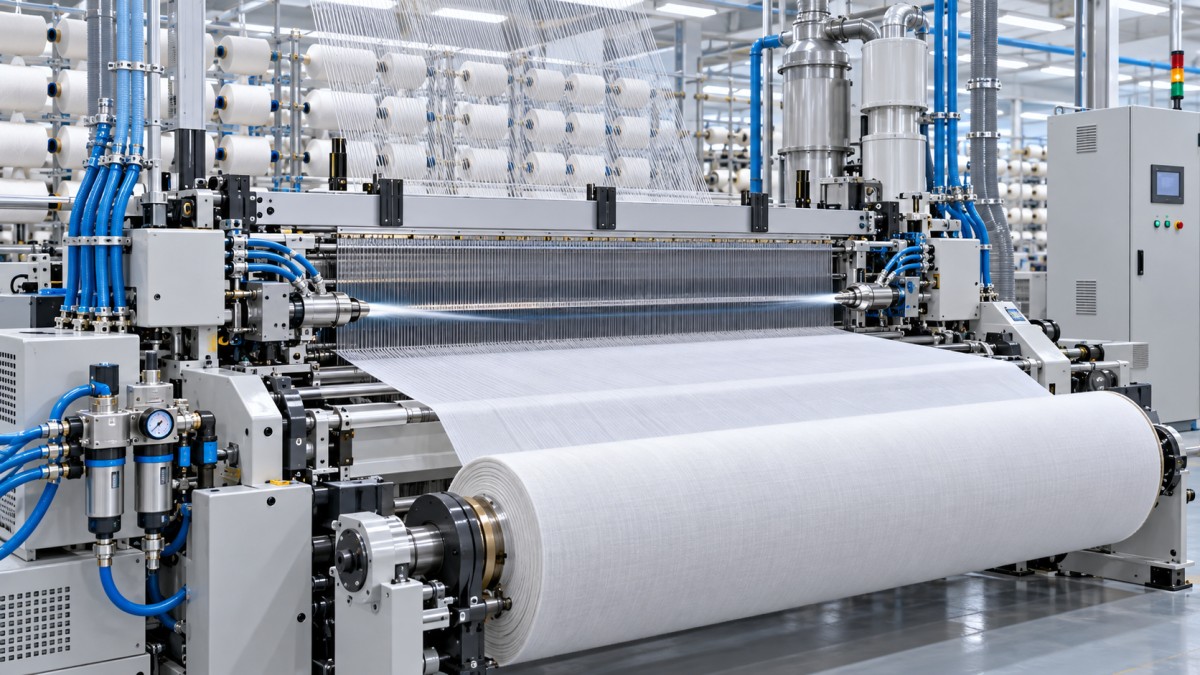
An air-jet loom uses a main nozzle to launch the weft yarn and relay nozzles to sustain and guide the yarn along the reed width. Electronic timing coordinates shed opening, air-valve activation, weft arrival sensing, beat-up, and let-off/take-up motion. Because the weft is moved by air rather than a rigid projectile, insertion can be fast and repeatable for yarns that cooperate with the air stream.
The production gain is strongest when yarn properties, reed geometry, nozzle settings, and weaving construction have been matched as a system. A smooth filament yarn and a well-prepared spun yarn do not behave identically in the air channel. Hairiness, twist, moisture condition, package build, yarn diameter, and surface finish alter drag and stability. Treating all yarns as though they need the same air pressure is a common source of excess consumption and unstable insertion.
Air pressure should not be interpreted as a direct quality setting. Raising pressure may clear an occasional late pick, yet excessive pressure can cause yarn flutter, nozzle turbulence, unnecessary energy use, and abrasion at guides. A low-pressure setting can look efficient on a utility meter while creating intermittent arrival failures that interrupt the weaving cycle. The appropriate setting is the lowest stable pressure range at the intended speed and width, verified over enough running time to expose variation between packages.
Weft insertion speed also interacts with fabric width. A wider reed requires the weft to travel farther through the shed, so a setting that performs well on a narrow construction may become marginal when width increases. This is why loom rotational speed alone is a poor basis for comparing capacity. Picks per minute, effective weaving width, planned construction, actual stop frequency, and accepted fabric length need to be reviewed together.
Electronic control reduces the hidden losses between fabric styles
The raw insertion rate attracts attention, but electronic control often creates the larger operational benefit over a mixed production schedule. Servo-controlled let-off and take-up regulate warp delivery and fabric advance with greater precision than manual adjustments. Electronic dobby or jacquard interfaces can coordinate pattern selection with the weaving cycle. Weft selectors, colour feeders, and fault detection systems reduce the amount of physical intervention required when a construction calls for multiple wefts or programmed sequences.
Stored style settings make repeat orders and planned transitions more consistent. A production record can retain loom speed, main and relay nozzle timing, warp tension targets, pick density, weft feeder settings, and fabric-specific alarm limits. This does not eliminate setup work. Reed condition, yarn lot variation, beam preparation, and environmental conditions still need examination. It does, however, replace part of the trial-and-error adjustment process with a controlled starting point.
A useful distinction is between a style change and a beam change. Changing pick density, nozzle timing, or an electronically controlled pattern may be relatively quick once the mechanical preparation is complete. Replacing a warp beam, drawing in a new warp, changing a reed, or correcting damaged healds remains a physical task with its own critical path. Planning often overstates flexibility when it counts only the parameter download and ignores these preparation activities.
The sequence around a changeover affects the following run. If the incoming beam is not checked for end breaks, lease clarity, and tension consistency before it reaches the loom, troubleshooting moves into productive time. Likewise, a sample that is approved for appearance but not checked for actual pick density, width, selvedge construction, and downstream finishing behaviour can create a longer interruption later. Air-jet looms shorten controllable adjustment time; they do not compensate for incomplete technical release information.
Stable warp preparation protects high-speed output
At high weaving speeds, many stoppages originate upstream of the air-jet insertion system. Warp tension variation, weak sizing, poor winding, damaged drop wires, contamination, or inconsistent beam build can cause repeated warp breaks. The loom records the stop, but the underlying defect may lie in warping, sizing, or beam handling. Increasing loom speed before resolving these sources frequently raises the number of interruptions faster than it raises accepted output.
Sizing deserves particular attention for staple-spun warp yarns. The size film must provide sufficient abrasion resistance and coherence during heald and reed passage without making the yarn unduly brittle or causing excessive shedding. A warp that appears acceptable at reduced speed can fail under increased cyclic loading. Conversely, a heavy or poorly conditioned size layer may increase lint, deposits, and cleaning burden. The most productive setting is tied to stable weaving performance and subsequent desizing requirements, not simply to the strongest apparent film.
Warp tension should be assessed across the width rather than only at a central reading. Uneven tension can produce localized end breaks, banding, width variation, or a distorted shed. These defects may be mistaken for a nozzle or timing issue because they appear during weft insertion. Observing where faults occur, whether they repeat at the same warp position, and whether they follow a beam or loom helps separate warp-related causes from insertion-related causes.
Quality consistency preserves the output gain
High throughput has little value when inspection identifies defects that require downgrading, cutting out, reweaving, or remaking downstream orders. Air-jet looms support quality consistency through repeatable electronic timing, controlled yarn delivery, and monitoring of key events such as weft arrival and warp breaks. The control system is most effective when its alarms are interpreted as process evidence rather than bypassed to maintain nominal speed.
Several defects can look similar on cloth but require different corrections. A missing or short pick may result from poor yarn package unwinding, feeder tension, a weak main-nozzle launch, blocked relay nozzles, incorrect arrival timing, or an unstable shed. A weft stop mark may be associated with a restart procedure, take-up response, or a change in yarn tension. A density variation may come from take-up control, loom timing, warp tension, or finishing shrinkage. Changing a single air setting in response to every visible mark can obscure the real cause.
Inspection feedback should be linked to loom and batch records promptly. When defect codes are vague, the same underlying event can be labelled differently by shift, making recurring losses difficult to see. Clear defect definitions, roll traceability, and a record of adjustments create a more reliable connection between fabric inspection and machine settings.
Compressed air is both the enabling medium and a production constraint
Air-jet weaving transfers part of the production burden from moving mechanical components to the compressed-air system. This makes air quality, pressure stability, piping design, filtration, and condensate control relevant to loom efficiency. A compressor installation sized only for average consumption can become unstable when many looms insert picks simultaneously or when leakage rises. Pressure dips may appear as isolated loom faults even though the root cause is central supply capacity or distribution loss.
Pressure should be measured near the loom under operating load, not inferred solely from a compressor-room gauge. Long pipe runs, undersized distribution lines, clogged filters, poorly maintained regulators, and leaks at connections can produce a different pressure at the nozzle inlet from the pressure shown at the source. Water or oil contamination can affect valves and nozzles, while airborne lint adds a separate blockage risk in textile environments.
Energy evaluation also needs a balanced boundary. Lowering air consumption per pick is desirable, but a reduction that produces more stop time or fabric defects is not an efficiency improvement. Useful assessment compares accepted fabric output, compressed-air energy, stop duration, quality loss, and maintenance effort for the same fabric construction. A setting change should be tested against a stable reference run rather than judged by one shift of observations.
Downtime reduction depends on fault recovery discipline
Fast looms amplify the cost of small interruptions. A few seconds lost repeatedly to yarn breaks, false weft stops, or manual resets can remove a meaningful share of scheduled output. The highest-return maintenance work is often not a major overhaul but consistent control of items that influence every pick: nozzle cleanliness, solenoid valve condition, sensor alignment, reed and heald condition, cutter performance, weft feeder calibration, and air leakage.
Preventive tasks should follow the actual failure pattern of each fabric family. Fine filament constructions may be sensitive to nozzle deposits and yarn-path damage. Hairy spun yarns may demand more frequent cleaning around guides, feeders, and sensors. Technical fabrics can place unusual demands on reed selection, shed geometry, and tension control. A generic maintenance interval without reference to yarn type, construction, and dust load can either waste planned downtime or allow repeat faults to develop.
Stop data becomes useful when it distinguishes duration from frequency. A rare extended stop may point to a mechanical failure or missing spare part. Hundreds of short weft-related stops suggest an insertion stability issue, package problem, or sensor threshold that requires technical investigation. Counting only total stop minutes can hide the repetitive losses that disrupt rhythm and increase fabric marks after restarts.
Capacity decisions should be based on usable output
Air-jet looms are particularly effective where fabric demand requires high-volume output, short production windows, or frequent controlled style transitions. Their fit is weaker when yarn characteristics are poorly suited to pneumatic insertion, when compressed-air infrastructure is inadequate, or when upstream warp quality is inconsistent. The loom selection decision therefore belongs to a process review that includes yarn preparation, air supply, maintenance capability, quality inspection, and the expected mix of fabric widths and constructions.
Before approving a production target, establish a baseline using actual accepted roll length, planned and unplanned stops, defect disposition, air consumption, and setup duration. Then test changes one at a time where possible: a nozzle-timing adjustment, feeder setting, speed increase, yarn package change, or maintenance intervention. This preserves causal evidence. When multiple parameters are changed together, a short-term improvement may be impossible to reproduce on the next order.
The practical value of air-jet weaving lies in disciplined synchronization. Yarn preparation must support the selected speed, pneumatic delivery must remain stable through the full shift, electronic settings must reflect the real construction, and inspection feedback must return to the loom quickly enough to prevent repeat loss. Under those conditions, fast weft insertion becomes consistent fabric throughput rather than an isolated machine specification.
- Textile IoT Capital & EconomicsVDMA Opens ITMA 2027 Technical Delegation Pre-RegistrationVDMA opens ITMA 2027 technical delegation pre-registration. Explore German textile machinery, digital innovation and sustainability. Register interest by December 11, 2026.
- Fast Fashion & Agile MfgTextile OEM Compliance Evaluation: What to Check in a Supplier AuditTextile OEM compliance evaluation made practical: discover key supplier audit checks for quality, machinery, chemicals, traceability, and environmental risks.
- Textile IoT Capital & EconomicsTariffs and Inflation Weigh on Demand as U.S. Apparel Imports Fall to $56.68 BillionU.S. apparel imports fell 6.14% to $56.68 billion as tariffs and inflation weighed on demand. Explore what this could mean for buyers and exporters.
Related News
Get weekly intelligence in your inbox.
No noise. No sponsored content. Pure intelligence.
