




A textile machinery quote can look straightforward until production reality enters the conversation. One supplier offers a lower purchase price; another offers more automation, a faster stated speed, and a longer list of digital features. The decision becomes difficult because textile equipment is not bought simply by the machine. It is bought for the usable output it can deliver across changing fabrics, order sizes, operators, utility conditions, and maintenance windows.
When comparing prices for textile machinery, procurement teams should start with a more practical question than “Which machine costs less?”: “What does each machine cost per usable unit of production under our actual operating conditions?” That applies whether the purchase involves air-jet looms, digital textile printers, low-liquor-ratio dyeing systems, stenter frames, computerized knitting equipment, or automated cutting lines.
The headline price still matters. Cash flow, financing terms, installation scope, and spare-parts commitments are real constraints. But a low initial quote can become expensive if the equipment requires more operators, produces a high level of off-quality fabric during changeovers, consumes disproportionate energy, or cannot adapt to the small-batch rhythm increasingly demanded by fashion and technical-textile supply chains.
Throughput is not the same as rated speed
Manufacturers usually present capacity through a maximum speed specification: picks per minute for weaving, metres per minute for printing or finishing, kilograms per batch for dyeing, or cutting length and ply height for automated cutting. Those figures are useful, but they are not a purchasing answer by themselves.
A loom running a stable construction with a familiar yarn package may approach its rated performance. The same loom may behave very differently when a mill changes yarn count, weave density, weft type, or humidity conditions. On digital printing lines, a quoted print speed may relate to a particular resolution, pass mode, ink configuration, and fabric preparation. A buyer planning frequent design changes should pay more attention to usable production time than to a peak brochure number.
For cost comparison, it is more revealing to request an estimated production model based on the buyer’s own mix of fabrics and orders. This model should distinguish between:
- rated machine speed and expected operating speed;
- planned production hours and realistic uptime assumptions;
- setup, cleaning, color-change, style-change, and calibration time;
- yield loss from defects, print misalignment, dyeing rework, or cutting waste;
- the output level at which an additional operator, shift, or support technician is required.
This is where two machines with apparently similar prices can separate sharply. A more expensive machine may have a modest advantage in speed but a much stronger advantage in restart stability, automatic fault handling, or repeatability after a style change. For a factory running long, predictable orders, that difference may not justify the premium. For a supplier handling fragmented fast-fashion programs, it may be the decisive factor.
Automation changes the cost structure, not just the operator count
Automation is often priced as an add-on package, which makes it tempting to remove during negotiations. That can be sensible, but only after identifying what the feature actually replaces. Some automation mainly improves convenience; some protects quality or reduces a recurring production bottleneck.
In weaving, automated weft handling, electronic controls, condition monitoring, and integrated data capture can reduce reliance on manual intervention. Their value is highest where machine stops are frequent, skilled loom technicians are hard to retain, or production planning depends on fast visibility into loom status. In a plant with stable labor availability and simple fabric constructions, a basic configuration may remain the more rational choice.
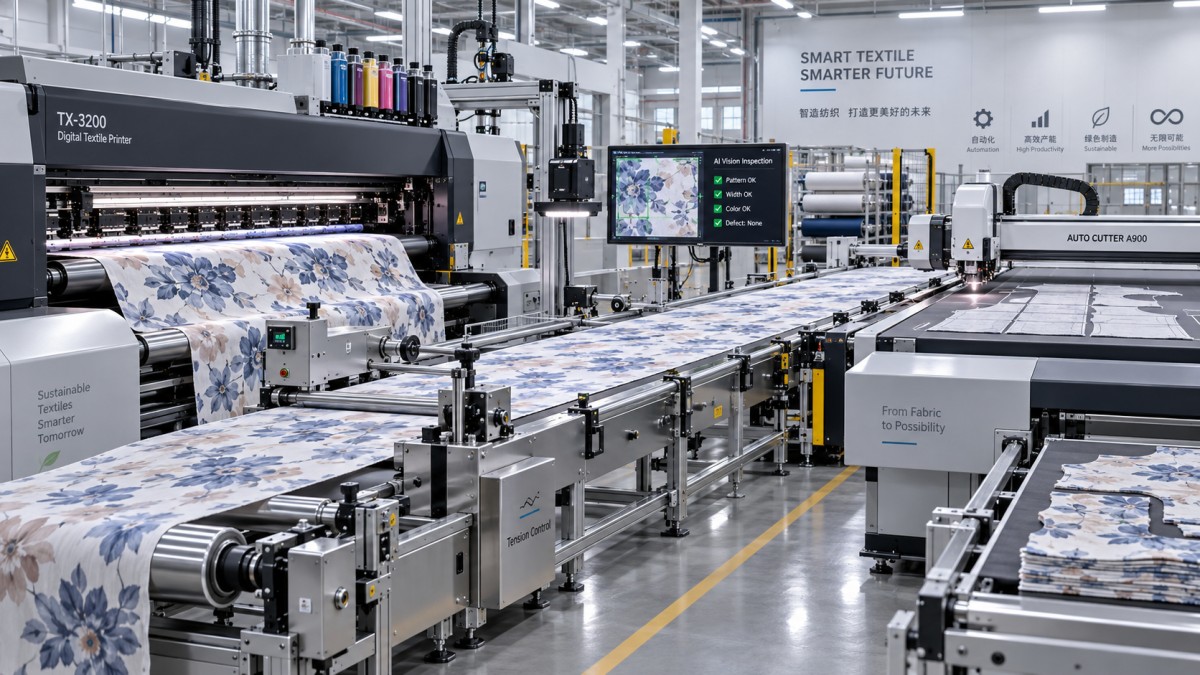
Digital textile printing provides a different example. Automation around fabric feeding, tension control, drying, inspection, and workflow integration can matter as much as the printer itself. A printer capable of producing fine detail is not necessarily a high-throughput line if fabric loading, pretreatment, curing, or post-print handling remains manual. Buyers should price the line around the print engine, not only the print engine.
Automated cutting is even more sensitive to the surrounding process. A cutting table with a high-frequency oscillating blade and camera-assisted alignment can reduce material loss, particularly where plaid matching, stripes, curved panels, or multi-layer cutting create manual complexity. Yet its return depends on marker quality, fabric relaxation, spreading accuracy, bundle handling, and whether the sewing floor can absorb the released volume. Installing a sophisticated cutter in front of an unchanged manual workflow can simply shift the queue downstream.
A useful comparison: price against operating pattern
This comparison also explains why “best value” does not always mean “most automated.” An automation-heavy configuration is generally easier to defend when it protects a scarce input: skilled labor, expensive fabric, limited floor space, process water, energy capacity, or production time. If none of these constraints is pressing, the premium needs closer scrutiny.
Utility costs can overturn a cheap equipment decision
Textile manufacturing converts large quantities of air, heat, water, steam, electricity, chemicals, and compressed air into fabric performance. That is particularly visible in dyeing and finishing, where the machine price is only one part of a much larger process-cost equation.
For dyeing equipment, buyers should ask how the system performs with the intended fiber types, shades, batch sizes, and process recipes. An ultra-low liquor-ratio design may reduce water and heating demand under suitable conditions, but the real outcome depends on loading discipline, dosing systems, process control, washing requirements, and the factory’s wastewater setup. Waterless approaches such as supercritical CO2 dyeing require an even more careful project-level assessment because infrastructure, compatible materials, and operating know-how can influence the business case.
Stenter and finishing equipment deserve the same discipline. Temperature uniformity, exhaust management, heat recovery options, dwell control, and fabric width variation all influence results. A lower-priced stenter with weak control over the actual production window can create hidden costs through shade inconsistency, shrinkage variation, rework, and unnecessary energy consumption. Procurement should involve production and quality teams early; neither department can evaluate this equipment well from a commercial specification alone.
For air-jet weaving, compressed-air demand deserves special attention. The loom’s price may be competitive while the required air system upgrade is not. Ask suppliers to clarify the basis of any air-consumption figure and examine whether it reflects the planned yarn, reed width, insertion conditions, and fabric construction. It is a small detail in a quotation and a large cost line over years of operation.
Quote scope is where many comparisons become misleading
A machinery quotation should be normalized before it is ranked. One supplier may include installation supervision, commissioning, starter spare parts, software licenses, operator training, and remote support. Another may quote the base machine only. Neither approach is automatically wrong, but the totals are not comparable until the scope is brought to the same level.
The practical checklist is longer than most buyers expect. Besides equipment price, confirm freight terms, import duties where applicable, foundations, power upgrades, compressed air, water treatment, steam, exhaust systems, civil works, installation labor, consumable parts, initial tooling, software subscriptions, and acceptance testing. For digital printers, ink supply arrangements and printhead maintenance terms need particular attention. For cutting systems, check whether pattern software, nesting capability, spreading interfaces, and material handling are included or separately licensed.
Service response should not be treated as a vague promise. Ask where technicians are located, which parts are stocked regionally, what diagnostic access is available, and what the supplier expects the factory to maintain in-house. A machine that is technically excellent but difficult to support can be a poor fit for a remote plant or a factory with limited engineering depth.
Build the comparison around cost per sellable output
The most grounded approach to comparing prices for textile machinery is to build a simple internal model rather than chase a universal payback period. Use the purchase and installation cost, then add expected utilities, labor, maintenance, consumables, and likely fabric loss. Divide this by sellable output, not theoretical output. If the machinery enables higher-value orders, shorter lead times, or a wider fabric range, those benefits can be included, but only when the commercial team can realistically capture them.
It is also worth testing the model under less comfortable conditions: lower order volume, more frequent style changes, a delayed operator ramp-up, or a temporary reduction in machine availability. Equipment that only pays back under perfect utilization is not necessarily a bad investment, but it carries more execution risk.
ATFS follows this wider lens across high-speed weaving, precision digital printing, lower-impact dyeing and finishing, knitting, and flexible cutting systems. The common thread is that machinery is increasingly part of an interconnected production system. Machine vision, recipe control, fluid and thermal management, and factory data connectivity all affect whether a textile producer can respond quickly without sacrificing fabric quality or resource discipline.
Before issuing the purchase order
Ask suppliers to demonstrate the equipment on representative materials whenever possible. The goal is not a polished showroom test; it is to understand limits. Bring the difficult fabric, the recurring colorway, the awkward pattern, or the construction that causes real stoppages. Clarify the acceptance criteria in advance, including what quality result, production condition, and support scope will be used to judge commissioning.
The strongest machinery decision is usually not the one with the lowest quote or the most features. It is the one whose throughput remains credible after changeovers, whose automation matches the factory’s real constraints, and whose full operating cost is visible before the contract is signed. In textile production, that clarity is often worth more than a discount negotiated at the end of the tender.
- Textile IoT Capital & EconomicsVDMA Opens ITMA 2027 Technical Delegation Pre-RegistrationVDMA opens ITMA 2027 technical delegation pre-registration. Explore German textile machinery, digital innovation and sustainability. Register interest by December 11, 2026.
- Fast Fashion & Agile MfgTextile OEM Compliance Evaluation: What to Check in a Supplier AuditTextile OEM compliance evaluation made practical: discover key supplier audit checks for quality, machinery, chemicals, traceability, and environmental risks.
- Textile IoT Capital & EconomicsTariffs and Inflation Weigh on Demand as U.S. Apparel Imports Fall to $56.68 BillionU.S. apparel imports fell 6.14% to $56.68 billion as tariffs and inflation weighed on demand. Explore what this could mean for buyers and exporters.
Related News
Get weekly intelligence in your inbox.
No noise. No sponsored content. Pure intelligence.
