




Maintenance costs vary across textile machines because each machine fails, wears, and loses productivity in a different way. A high-speed air-jet loom may have modest routine parts costs but expensive downtime when a recurring fault disrupts a production run. A digital textile printer can appear mechanically simple while carrying a high ongoing burden from printhead care, ink-system cleanliness, and environmental control. Dyeing and finishing equipment often concentrates cost in pumps, seals, heat-transfer components, and compliance-critical water or chemical handling. For a financial approver, the useful comparison is therefore not “which machine is cheapest to maintain?” but “which maintenance profile fits our operating model, production mix, and tolerance for lost output?”
The purchase price and annual service-contract quote are only the starting point. Maintenance should be evaluated as a combination of scheduled labor, consumables, replacement parts, specialist support, utilities-related wear, software and controls, inventory held for critical spares, and the margin lost during unplanned stoppages. Machines serving short runs, premium fabrics, or deadline-sensitive fashion programs can justify higher planned maintenance spending when it prevents a disruption at the wrong point in the order cycle.
Why similar maintenance budgets can produce very different business outcomes
Two plants may spend a similar amount per machine on maintenance and still face very different financial consequences. The first may run stable, high-volume orders on a machine with predictable mechanical wear. The second may run frequent style changes, delicate materials, variable designs, or tight delivery windows. In the second case, a minor sensor, nozzle, blade, or tensioning issue can hold up a much larger portion of the workflow.
Maintenance cost should therefore be assessed against productive hours, changeover frequency, fabric value, batch value, and the availability of alternate capacity. A machine that can be bypassed or backed up by another line carries a different downtime risk from a bottleneck machine that controls printing, dyeing, or cutting for an entire order.
A practical approval model separates four cost layers:
- Routine preventive maintenance: cleaning, lubrication, calibration, inspections, and planned replacement of known wear items.
- Corrective maintenance: repairs following mechanical, electrical, pneumatic, hydraulic, thermal, or software-related failures.
- Production-loss exposure: labor waiting time, delayed batches, rework, scrapped material, expedited transport, and missed delivery windows.
- Capability-preservation costs: work required to keep color accuracy, print quality, cutting precision, fabric consistency, safety, or environmental performance within acceptable limits.
The first two categories are visible in maintenance budgets. The latter two often appear elsewhere in financial reporting, which can make a low-cost maintenance decision look better than it is.
High-speed weaving machines: frequent mechanical attention, high downtime sensitivity
High-speed weaving equipment, particularly air-jet and other automated looms, tends to have a maintenance profile driven by moving parts, yarn handling, air systems, lubrication, and alignment. The machine’s productivity depends on consistent interaction between warp preparation, weft insertion, shedding, take-up, and electronic controls. A failure in one area can manifest as higher stop rates, quality defects, or reduced speed long before it becomes a complete breakdown.
Routine costs are usually associated with wear components, cleaning, lubrication systems, air preparation, sensors, tension-related parts, and periodic adjustment. In facilities with poor compressed-air quality, the pneumatic system can create a disproportionate maintenance burden through contamination, moisture, pressure instability, and accelerated wear. The financial question is not limited to the loom itself: the cost of maintaining compressors, dryers, filters, and air-distribution infrastructure belongs in the operating picture for air-jet production.
Weaving maintenance is often operationally manageable when the mill has strong technician coverage, standardized loom fleets, disciplined preventive schedules, and reliable spare-parts access. Costs rise when production relies on many machine generations, nonstandard components, difficult yarns, or frequent fabric construction changes. A low spare-parts price does little to protect margins if a recurrent fault causes repeated loom stops across a large fleet.
For approval purposes, high-speed looms should be assessed through expected efficiency and stop-rate control. A maintenance package that includes condition monitoring, operator diagnostics, and rapid access to common spares may be financially stronger than a lower-cost arrangement that leaves technicians reacting after throughput has already declined.
Digital textile printers: consumables and process discipline matter as much as mechanics
Industrial digital textile printers shift part of the maintenance burden away from conventional mechanical assemblies and toward printheads, ink delivery, filtration, cleaning cycles, vacuum or wiping systems, fabric transport, software, and environmental conditions. The cost pattern is less forgiving of inconsistent operating discipline. Infrequent use, improper shutdown procedures, incompatible fluids, poor filtration, or inadequate humidity and temperature management can contribute to nozzle issues, color inconsistency, and reduced printhead life.
The replacement value and service implications of printheads make this category particularly important for finance teams. A printer with a lower acquisition cost may have a less favorable long-term profile if its printhead replacement process is costly, its cleaning requirements consume significant ink or fluids, or its service model depends heavily on specialist intervention. Conversely, a higher-cost machine can be easier to justify where its diagnostics, ink management, and automated maintenance functions reduce avoidable failures.
Digital printing also requires a broader definition of maintenance. Color management, software updates, file-processing reliability, and calibration are not optional administrative tasks. They protect saleable output. A printer that continues running while drifting outside approved color tolerance can generate a more expensive problem than a visible stoppage, especially for branded programs, repeat orders, or coordinated garment collections.
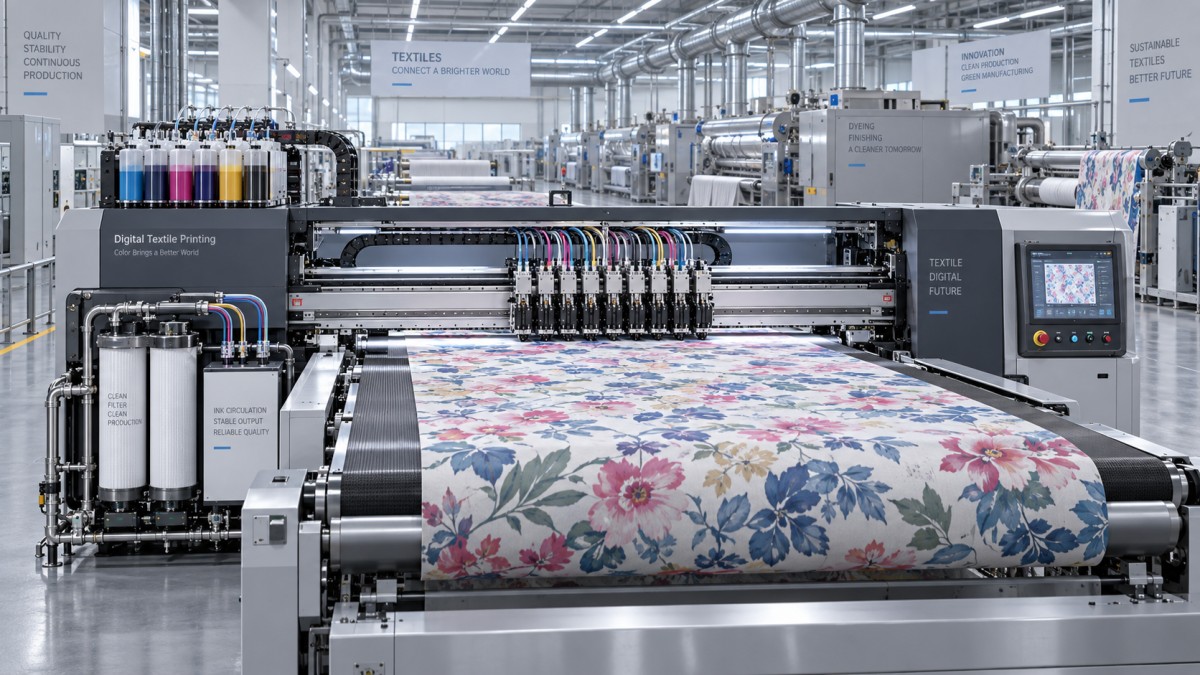
Financial reviews should ask how the machine will be used between jobs. A printer operating daily on varied short runs has different risk than one used intermittently for sampling or seasonal bursts. The latter may need a documented preservation routine, operator training, and a clear decision on whether the business can carry the cost of idle equipment maintenance. Utilization is not simply a revenue assumption; it directly affects the condition and cost of the asset.
Dyeing and finishing systems: maintenance is tied to heat, chemistry, water, and environmental controls
High-temperature dyeing and finishing machinery can carry some of the most consequential maintenance exposure in a textile operation because process reliability depends on pressure, temperature, circulation, dosing, washing, drying, and exhaust performance. Pumps, valves, seals, heat exchangers, piping, filters, circulation components, burners or heating systems, and control instrumentation operate under conditions that can accelerate degradation.
For conventional wet processing, water quality and chemical management influence both fabric results and equipment life. Scaling, corrosion, contamination, blocked filters, degraded seals, and inaccurate dosing can gradually increase utility use and create quality variation before an obvious equipment failure occurs. The maintenance burden of a low-liquor-ratio or more resource-efficient system should be assessed with the whole process in view: reduced water or energy use can improve lifecycle economics, but specialist components, tighter process tolerances, or new operator requirements may alter the maintenance plan.
Waterless or highly specialized dyeing technologies deserve separate scrutiny. Their environmental and operating benefits may be strategically attractive, but financial approval should not assume that a lower-water process automatically means low maintenance. Equipment operating with pressurized fluids, sophisticated recovery systems, or specialized thermal controls may require technicians with different capabilities, carefully managed spare parts, and vendor support that is not easily substituted locally.
The most important cost risk in dyeing and finishing is often a compromised batch rather than the repair invoice. A component failure that affects temperature uniformity, circulation, dwell time, chemical dosing, or drying can lead to reprocessing, shade variation, fabric damage, or delayed downstream production. Maintenance planning should therefore be linked to the value and sensitivity of the batches being processed, not only to machine age.
Knitting equipment: precision wear and software support shape the cost curve
Computerized flat knitting machines and advanced warp knitting equipment combine precision mechanical systems with increasingly complex electronic control. Needles, sinkers, yarn feeders, guide elements, cams, lubrication, take-down systems, and tension devices require routine attention. The cost of these items can be relatively predictable where the product range is stable and operators identify early signs of wear.
Complexity increases when the equipment produces engineered structures, seamless garments, technical textiles, or multi-axial reinforcement fabrics. In these applications, a small mechanical or programming issue may not stop the machine immediately but can create defects that are only visible after inspection, assembly, or downstream processing. The maintenance budget should include software support, file management, calibration, technician capability, and quality-control feedback loops.
Approvers should be cautious about treating knitting maintenance as a simple consumables calculation. The financial exposure depends on whether the machine’s output is a commodity fabric that can be reworked or a technically specified component with limited recovery options. A lower failure frequency does not eliminate risk when every defective run carries high material or customer-acceptance consequences.
Automated cutting lines: lower mechanical bulk, but expensive precision failures
Flexible automated cutting lines often have a maintenance profile centered on blades, bristle beds or support surfaces, vacuum systems, conveyors, motion components, cameras, sensors, cutting heads, and nesting or control software. Blade replacement and routine cleaning are visible recurring costs. Less visible costs arise from degraded cutting accuracy, poor vacuum performance, camera misalignment, material handling faults, and software interruptions.
These systems are frequently approved on labor savings and fabric utilization. That makes maintenance especially relevant: a modest reduction in nesting accuracy, cut quality, or stripe and plaid matching can erode the very savings used to support the investment case. The financial model should track material yield and recut rates after commissioning, not merely machine availability.
Automated cutters can be economical to maintain when workloads are sufficiently steady, materials are within the machine’s intended range, operators follow blade and cleaning routines, and technical support can resolve software or vision-system issues quickly. They are harder to justify when utilization is low, material variety creates frequent setup complexity, or the plant lacks process discipline around marker preparation and fabric spreading. In such cases, the machine may still be strategically useful, but its maintenance and support costs should be treated as part of the capacity decision.
A comparison framework for capital approval
The most defensible maintenance estimate is built from the intended operating conditions rather than an average percentage of equipment price. Ask suppliers to define scheduled tasks by operating hour or production volume, identify consumables and life-limited parts, distinguish remote support from on-site intervention, and state which components require factory-certified service. The same request should identify exclusions, travel costs, software licensing, calibration requirements, and recommended critical-spares holdings.
Finance teams should also challenge a common assumption: an extended warranty or service contract does not automatically reduce total risk. Its value depends on response time, parts coverage, exclusions, local technical capability, and whether the contract addresses production recovery rather than only replacement parts. A contract that restores a machine after several days may offer limited protection for a plant running tightly scheduled short orders.
The best comparison is a scenario-based one. Model expected maintenance spending under normal operation, then test the effect of a critical failure during a peak production period. Include the cost of idle labor, substitute capacity, quality loss, expediting, and delayed shipment where those exposures apply. This approach usually reveals why the maintenance economics of textile machinery differ so sharply: the cost is determined as much by the production system around the machine as by the machine itself.
- digital textile printing
- automated cutting lines
- flexible automated cutting
- textile machinery
- digital textile printers
- dyeing and finishing machinery
- computerized flat knitting machines
- computerized flat knitting
- industrial digital textile printers
- weaving equipment
- finishing machinery
- dyeing and finishing equipment
- Textile IoT Capital & EconomicsVDMA Opens ITMA 2027 Technical Delegation Pre-RegistrationVDMA opens ITMA 2027 technical delegation pre-registration. Explore German textile machinery, digital innovation and sustainability. Register interest by December 11, 2026.
- Fast Fashion & Agile MfgTextile OEM Compliance Evaluation: What to Check in a Supplier AuditTextile OEM compliance evaluation made practical: discover key supplier audit checks for quality, machinery, chemicals, traceability, and environmental risks.
- Textile IoT Capital & EconomicsTariffs and Inflation Weigh on Demand as U.S. Apparel Imports Fall to $56.68 BillionU.S. apparel imports fell 6.14% to $56.68 billion as tariffs and inflation weighed on demand. Explore what this could mean for buyers and exporters.
Related News
Get weekly intelligence in your inbox.
No noise. No sponsored content. Pure intelligence.
